

AI Assistants for Field Operations: Features, Benefits, and Use Cases
Discover how AI assistants help field operations teams access real-time information, manage work orders, monitor equipment, support dispatch, track rentals, and make faster operational decisions.
- Artificial Intelligence
Field operations rarely slow down because teams lack effort. They slow down because the information needed to make decisions is spread across work orders, emails, spreadsheets, asset records, maintenance systems, rental logs, and conversations with the yard or back office.
A technician may need to confirm whether a part is available. A dispatcher may need the latest job status. An operations manager may need to know which equipment is idle, delayed, under maintenance, or ready for reassignment. In many organizations, finding these answers still requires multiple phone calls, system searches, and manual updates.
AI assistants for field operations are designed to reduce that friction. Instead of expecting employees to search through several systems, an AI assistant helps them ask questions, retrieve operational information, summarize activity, and take the next appropriate action from one connected interface.
For asset-heavy industries, this can improve how field teams, dispatchers, maintenance teams, rental coordinators, and operations leaders manage daily work.
What Is an AI Assistant for Field Operations?
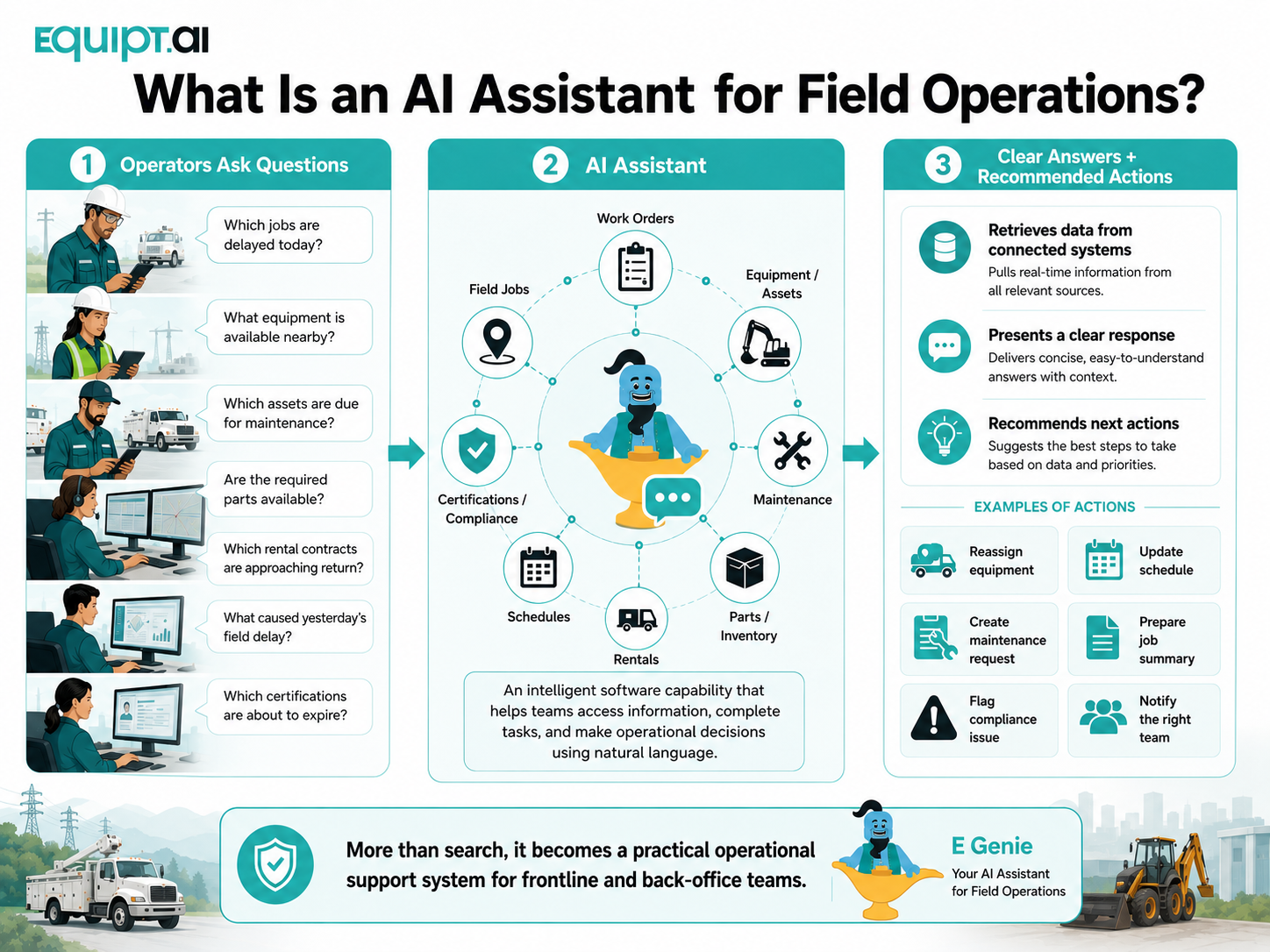
An AI assistant for field operations is an intelligent software capability that helps employees access information, complete tasks, and make operational decisions using natural language.
Rather than navigating through multiple menus or building reports, users can ask questions such as:
Which jobs are delayed today?
What equipment is available near this location?
Which assets are due for maintenance?
Are the required parts available for this work order?
Which rental contracts are approaching their return date?
What caused the delay in yesterday’s field job?
Which certifications are about to expire?
The AI assistant interprets the question, retrieves relevant information from connected operational systems, and presents a clear response.
More advanced assistants can also recommend actions. They may suggest reassigning equipment, updating a schedule, creating a maintenance request, preparing a job summary, flagging a compliance issue, or notifying the relevant team.
This makes the assistant more than a search tool. It becomes a practical operational support system for frontline and back-office teams.
How AI Assistants Fit Into Field Operations
Field operations involve continuous coordination between people, equipment, locations, parts, schedules, customers, and documentation.
A single job may require:
The correct technician
Available and certified equipment
Required tools and spare parts
Site access documentation
Safety instructions
Customer information
Maintenance history
Rental or ownership records
Work completion evidence
Billing and closeout details
When these records are stored in disconnected systems, teams spend significant time locating and validating information.
An AI assistant creates a conversational access point across this operational data. It does not necessarily replace existing systems. Instead, it can work alongside platforms such as ERP, field service management, asset management, inventory, rental, maintenance, and CRM systems.
This is particularly valuable for organizations using oil and gas software, where field activity often depends on real-time coordination between equipment, crews, service locations, compliance records, and job requirements.
Key Features of an AI Assistant for Field Operations
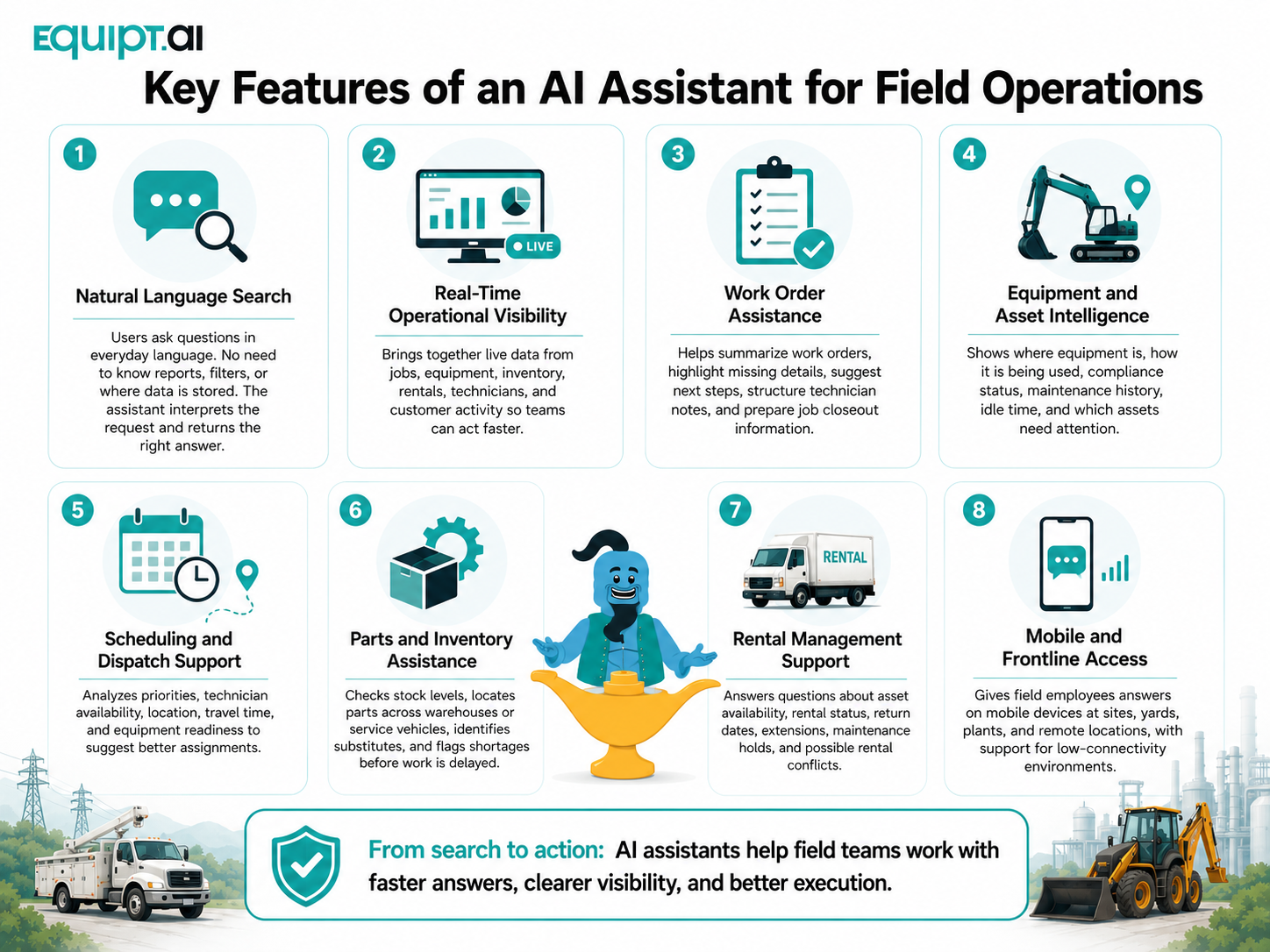
Natural Language Search
One of the most useful features is the ability to ask operational questions in everyday language.
Employees do not need to know which report to open, which field to filter, or where the information is stored. The assistant interprets the request and provides a relevant answer.
This can make operational data more accessible to technicians, supervisors, dispatchers, and managers who may not work with reporting tools every day.
Real-Time Operational Visibility
AI assistants can bring together live information related to jobs, equipment, inventory, rentals, technicians, and customer activity.
A dispatcher can quickly identify delayed jobs. A maintenance manager can review equipment approaching a service threshold. A rental coordinator can check which assets are available, reserved, in transit, or overdue.
This helps teams respond to changing field conditions without waiting for manually prepared reports.
Work Order Assistance
Field teams often spend a significant amount of time reviewing job instructions, entering notes, updating statuses, and preparing closeout information.
An AI assistant can help by:
Summarizing work order details
Highlighting missing information
Suggesting the next step
Converting technician notes into structured updates
Identifying incomplete documentation
Preparing job completion summaries
Flagging tasks that require supervisor attention
This reduces administrative effort and supports more consistent work order execution.
Equipment and Asset Intelligence
For asset-heavy organizations, equipment availability and condition directly affect productivity.
An AI assistant connected to oil and gas asset management software can help teams understand where equipment is located, how it is being used, whether it is compliant, and when maintenance is required.
Users may ask:
Which pressure control units are currently available?
Where was this asset last used?
Does this equipment have a valid inspection certificate?
Which machines have high idle time?
What maintenance was completed during the previous service?
Which assets are likely to require attention soon?
These answers help reduce unnecessary downtime and improve equipment utilization.
Scheduling and Dispatch Support
Dispatchers regularly make decisions based on job priority, technician availability, location, equipment readiness, travel time, and customer requirements.
An AI assistant can help analyze these variables and suggest suitable assignments. It may identify scheduling conflicts, highlight missing resources, recommend a nearby technician, or suggest alternative equipment.
The final decision remains with the dispatcher, but the assistant reduces the amount of manual checking required before making it.
Parts and Inventory Assistance
A field job can be delayed even when technicians and equipment are available if the required part is missing.
AI assistants can help employees check stock levels, locate parts across warehouses or service vehicles, identify approved substitutes, and review expected replenishment dates.
They may also alert teams when frequently used parts are running low or when a maintenance activity is scheduled without the required materials being available.
Rental Management Support
Rental operations involve reservations, dispatch, delivery, returns, inspections, maintenance, extensions, billing, and sub-rentals.
An AI assistant connected to equipment rental management software can answer questions about asset availability, rental status, contract dates, customer usage, return schedules, and maintenance holds.
It can also highlight potential conflicts, such as equipment being promised to a new customer before the current rental is expected to end.
Mobile and Frontline Access
Field employees need answers while working at customer sites, yards, plants, and remote locations.
A mobile-accessible AI assistant allows users to retrieve job information, equipment history, safety instructions, and inventory details without returning to a desktop system.
When combined with offline-capable field applications, the assistant can support teams in areas with limited connectivity and synchronize updates when the connection becomes available.
Benefits of AI Assistants for Field Operations
Faster Access to Information
The immediate benefit is reduced search time.
Employees no longer need to move between several systems, ask multiple departments, or wait for someone to prepare a report. They can receive relevant information through a direct question.
This helps teams make faster decisions during active field work.
Reduced Administrative Work
Technicians and supervisors are often responsible for documentation that takes time away from operational tasks.
AI assistants can help structure notes, summarize work completed, identify missing fields, and prepare closeout information. This reduces repetitive data entry while improving the consistency of records.
Better Equipment Utilization
When teams have clearer visibility into equipment location, availability, condition, and demand, they can make better assignment decisions.
This can reduce idle equipment, unnecessary rentals, scheduling conflicts, and avoidable purchases.
Improved Maintenance Planning
AI assistants can help identify assets that require preventive maintenance, inspections, or certification renewals.
They may also surface patterns in repair history, usage, downtime, and technician notes. This gives maintenance teams more context when prioritizing work.
Faster Response to Operational Issues
When a job is delayed, the first challenge is often understanding why.
An AI assistant can summarize the available information, including technician notes, equipment status, missing parts, scheduling changes, and customer updates.
This gives managers a clearer starting point for resolving the issue.
More Consistent Decision-Making
Operational decisions can vary depending on who is working, which system they check, and how much historical context they have.
AI assistants can provide standardized information and recommended actions based on current data, business rules, and previous activity. This supports greater consistency across locations and teams.
Stronger Connection Between the Field and Office
Frontline employees generate valuable operational information through job notes, inspections, status updates, photos, and equipment usage records.
An AI assistant helps turn that information into usable context for dispatchers, managers, maintenance teams, and finance teams.
It can also return office-side information to the field, creating a more connected flow of communication.
Common Use Cases Across Field Operations
Daily Operations Briefing
An operations manager can ask for a summary of active jobs, delayed work, equipment issues, technician availability, and urgent exceptions.
This provides a focused view of what needs attention without reviewing multiple dashboards.
Technician Job Preparation
Before reaching a site, a technician can request a summary of the job scope, equipment history, previous service notes, required parts, customer instructions, and safety documentation.
This improves preparation and reduces avoidable return visits.
Equipment Availability Checks
A dispatcher can ask which suitable assets are available within a specific area. The assistant can consider location, maintenance status, certifications, reservations, and current assignments.
Predictive Maintenance Support
The assistant can identify assets showing unusual usage, recurring faults, rising downtime, or upcoming service requirements.
Maintenance teams can then review the recommendations and schedule the appropriate action.
Rental Extension Management
Rental teams can identify contracts nearing their end date, check whether equipment is required for another reservation, and contact customers about returns or extensions.
Compliance Monitoring
The assistant can identify missing inspections, expired certificates, incomplete safety records, or equipment that should not be assigned until compliance requirements are completed.
Job Closeout
After field work is completed, the assistant can review submitted notes, labor hours, parts used, equipment usage, photos, and customer approvals.
It can flag missing information before the job moves to billing.
Operational Reporting
Managers can request summaries based on location, customer, equipment type, job category, or time period.
Instead of waiting for custom reports, they can retrieve the information through a conversational request.
What to Look for in a Field Operations AI Assistant
An effective assistant should be connected to real operational data rather than functioning as a separate chatbot.
It should understand the organization’s jobs, assets, customers, equipment, inventory, locations, work orders, and business processes.
It should also provide role-based access so users only see the information they are authorized to view.
Other important capabilities include:
Mobile accessibility
Integration with existing systems
Clear source data and audit trails
Configurable workflows
Secure access controls
Action recommendations
Human approval for critical decisions
Support for industry-specific terminology
Reliable performance in field environments
The most valuable AI assistants do not simply provide generic answers. They understand operational context and help employees move work forward.
E Genie: An AI Assistant Built for Field Operations
E Genie brings AI directly into Equipt.ai’s connected field operations platform.
Instead of asking teams to search across work orders, equipment records, maintenance history, rental activity, inventory, schedules, and field notes, E Genie helps them access operational information through natural language.
Teams can use E Genie to understand job status, review equipment availability, identify delays, locate parts, check maintenance requirements, summarize field updates, and determine what needs attention next.
Because it works within the operational environment, E Genie is designed to support real field decisions rather than provide disconnected, generic responses.
As an AI assistant for field operations, E Genie helps connect frontline activity with dispatch, maintenance, rental, inventory, and management teams.
The result is faster access to information, less administrative work, stronger operational visibility, and better coordination between the field and the office.
For organizations managing complex field operations, AI assistants are becoming more than a convenient search feature. They are becoming a practical way to help teams act on operational data when and where decisions are being made.

Aman Kaur
About the author
Dr. Hon. Amanpreet Kaur is the Co-Founder, CTO, and Chief AI Officer at Equipt.ai, where she builds operational AI for energy, industrial equipment, field teams, and critical infrastructure. With over 14 years of experience in enterprise technology and industrial operations, she writes about operational AI, digital twins, predictive maintenance, and enterprise-scale transformation.