
Predictive vs Proactive Maintenance: Operator's Guide
Predictive vs proactive maintenance explained for buyers, with where preventive still fits, where each model breaks, and how to choose the right mix.
- Equipment Management

A motor starts running hot. A pump throws off vibration. A field asset fails again for the third time this quarter. In each case, the breakdown is only part of the problem. The bigger problem is what happens next: a rushed work order, a missing part, a delayed crew, and a service window that slips when operations can least afford it. For field crews, our oilfield equipment maintenance checklist turns the routine side of this into daily, weekly and monthly steps.
That is why this is not a simple debate about preventive, predictive, or proactive maintenance. It is a decision about what should trigger action before a small issue turns into expensive disruption. And that decision matters more now because downtime is getting costlier with 31% of maintenance and operations managers said downtime costs increased in 2025, and 55% said higher parts costs were the main reason.
So when you look at predictive vs proactive maintenance, do not start with which model sounds more advanced.
Start with what your asset actually needs. Does this asset need a schedule, a signal, or a root-cause fix?
Overview
Preventive maintenance is schedule-led. Predictive maintenance is condition-led. Proactive maintenance is cause-led. The strongest operators do not treat them as competing philosophies. They use preventive maintenance for baseline control, predictive maintenance for timing on critical assets, and proactive maintenance to eliminate repeat failures that keep draining labor, parts, and uptime.
Preventive Vs Predictive Vs Proactive Maintenance — At a Glance
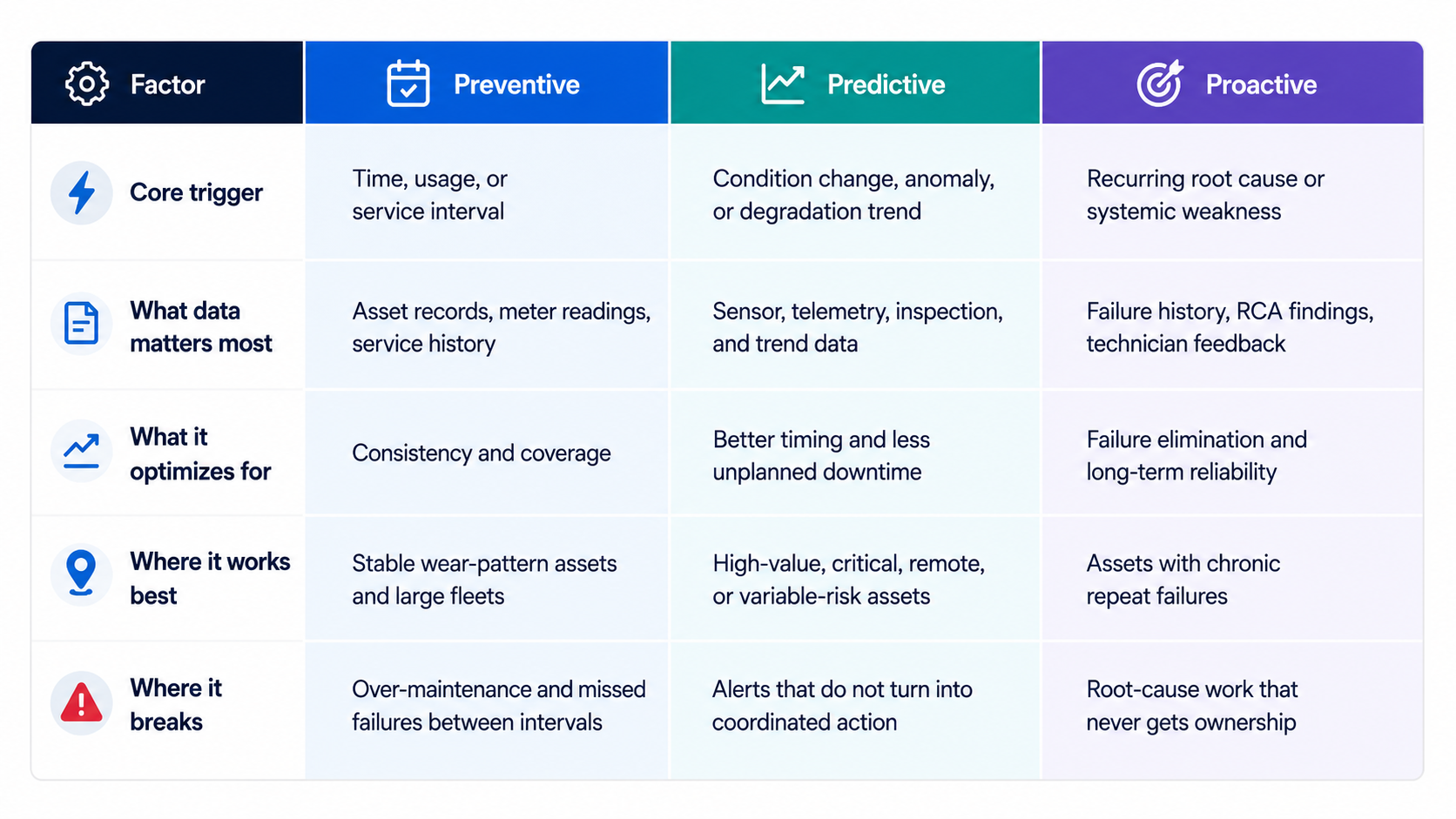
At a glance, the three strategies differ in what triggers the work:
Preventive maintenance: the trigger is the calendar or a meter (days, mileage, run hours, cycles). It needs good asset records and service discipline, suits assets with predictable wear and compliance inspections, and breaks as over-maintenance on some assets and surprise failures between intervals on others.
Predictive maintenance: the trigger is a change in condition (vibration, temperature, pressure, oil analysis, fault codes). It needs a trustworthy signal and a workflow from alert to work order, suits high-value, production-critical and remote assets, and breaks as alerts with no clean path to action.
Proactive maintenance: the trigger is a recurring cause (contamination, misalignment, a lubrication gap, a weak component). It needs failure history and an owner for each fix, suits assets with chronic repeat failures, and breaks as chronic issues everyone understands but no one owns.
What is the Real Difference Between Predictive vs Proactive Maintenance, and Where Does Preventive Maintenance Fit?
The cleanest way to compare these strategies is to ignore the buzzwords and look at what actually triggers work.
Preventive Maintenance: The Trigger is the Calendar or Meter
You act because the asset has reached a service interval. That interval may be based on days, mileage, run hours, cycles, or OEM guidance. This model needs relatively little live data. It depends more on asset records, service discipline, and the ability to plan work consistently.
Preventive maintenance is strong when wear patterns are stable, and the cost of missing a service window is clear. It is weaker when operating conditions vary so much that the interval no longer reflects real risk.
Predictive Maintenance: The Trigger is a Change in Condition
You act because the asset is showing a warning pattern. That signal may come from vibration, temperature, pressure, oil analysis, fault codes, electrical signatures, or a deviation from normal performance. Predictive maintenance does not try to predict everything. It tries to create a better intervention window than a fixed schedule can.
Hence, better timing can change both uptime and how effectively your team uses skilled labor.
Proactive Maintenance: The Trigger is a Recurring Cause
You act because the business has identified a repeat failure pattern, design weakness, contamination issue, alignment problem, lubrication gap, installation flaw, or planning error that keeps creating the same breakdown. Proactive maintenance is not just ‘doing maintenance earlier.’ It is about removing the conditions that make failure repeat.
Did you know?
The predictive maintenance market is projected to grow from $9.71 billion in 2026 to $16.74 billion by 2031. That growth is a good signal of buyer demand, but it does not mean every asset should move to predictive maintenance. It means more teams are trying to be selective about where better timing actually pays off.
Why this Comparison Matters Operationally?
Each choice changes how you plan labor, hold parts, reserve access windows, group work, and protect production. It also changes what failure looks like when the model breaks.
In a preventive-heavy environment, failure usually shows up as over-maintenance on some assets and surprise failures between intervals on others.
In a predictive-heavy environment, failure usually shows up as alerts with no clean path to action.
In a proactive-heavy environment, failure usually shows up as chronic issues everyone understands but no one owns.
Downtime risk: Which model actually shrinks your failure window?
Labor efficiency: Are your technicians doing the right work, or just scheduled work?
Parts readiness: Can you stage the component before the work becomes urgent?
Planning confidence: Can operations trust the maintenance plan to hold?
Execution speed: Does the signal convert into a work order, crew assignment, and completed job fast enough to matter? Digital work orders are what make that conversion measurable.
Where Does Reactive Maintenance Fit?
Reactive maintenance is the fourth model: the asset is repaired after it fails. It needs no schedule and no monitoring, which is why it becomes the default when planning slips. The cost arrives later as unplanned downtime, a rushed work order, a missing part and a delayed crew.
Proactive maintenance is the opposite of reactive maintenance. Reactive work fixes the breakdown; proactive work removes the cause so the same breakdown stops coming back. Preventive and predictive maintenance sit between the two, and organizations that lean on them experienced 52.7% less unplanned downtime than reactive-heavy peers.
Preventive Maintenance: Where it Works, Where it Wastes Effort
Preventive maintenance still earns its place because not every asset justifies continuous monitoring, advanced analytics, or a deeper reliability program.
Where Preventive Maintenance Works?
Assets with predictable wear patterns
Large fleets of similar equipment
Compliance-driven inspection routines
Low-to-medium criticality assets where standardization matters more than precision
Environments where service can be bundled efficiently by route, yard, or region
Where Preventive Maintenance Starts Wasting Money?
Preventive maintenance weakens when schedules replace judgment. You start servicing healthy assets too early, shutting down equipment that could have safely kept running, and consuming technician time on low-value tasks. It also misses failures that develop sharply between intervals.
Did you know?
Research shows that organizations leaning more heavily on preventive and predictive maintenance experienced 52.7% less unplanned downtime than reactive-heavy peers. That is an important reminder: preventive maintenance still creates value. The problem starts when it becomes your only lens.
Scenario: A Rental Fleet with Uneven Operating Conditions
A rental company services a group of generators every 250 run hours. For units in moderate conditions, that interval works well. But units deployed in dust-heavy environments degrade faster, while lightly used units come back for service with plenty of life left in the components.
That is the classic preventive maintenance trade-off. Some assets are over-maintained. Some are under-protected.
The schedule hides the difference.
For rental operations, equipment rental management software becomes far more useful when it gives teams enough asset context to schedule service at the right time, protect availability, and avoid treating every unit the same.
See how Equipt.ai helps rental teams align service timing, asset availability, and readiness in one flow! Talk to our experts today!
Predictive Maintenance: Where it Creates Real Leverage
Predictive maintenance matters when downtime is expensive, failure timing is variable, and the business needs more precision than a calendar can deliver.
What Predictive Maintenance Changes?
The value is not that the software is smarter. The value is that the intervention window gets tighter. Instead of servicing every asset on a broad schedule, you can focus your effort on the assets that are actually drifting toward failure.
Less unnecessary maintenance on healthy assets
Fewer emergency failures on critical equipment
More confidence in when to intervene
Better use of skilled technicians and planned access windows
What Has To Be True For Predictive Maintenance To Work?
The signal has to be trustworthy
The asset has to be important enough to justify the added monitoring
The team has to be able to act before the failure window closes
The workflow has to connect alert, triage, work order, parts, labor, and closeout
Scenario: A Remote Compressor Showing Early Degradation
A remote compressor begins showing rising vibration and heat. The asset is still running, but the trend is wrong. In a preventive model, the team may wait until the next service window. In a predictive model, they can step in before the failure becomes disruptive, align the visit with site access, stage the likely part, and send the right technician once.
That timing becomes even more critical in asset-intensive field environments, where teams rely on connected oil and gas asset management software to link asset health, job readiness, and field execution across remote operations.
Proactive maintenance: The Strategy Most Teams Misunderstand
Proactive maintenance is a maintenance strategy that finds the root cause of repeat failures and removes it, so the same breakdown stops coming back. Preventive maintenance acts on a schedule and predictive maintenance acts on a change in condition. Proactive maintenance acts on a recurring cause, such as a lubrication gap, contamination or a weak component.
Proactive maintenance is often described too loosely, as if it simply means fixing things earlier. That is not precise enough to help a buyer make a decision.
Proactive maintenance is about stopping repeat failure at the source. It asks why the same seal keeps failing, why the same job needs a second trip, or why the same contamination issue keeps returning after a repair. It is less about the next work order and more about changing the system that keeps generating the work order. To decide which of these strategies each failure mode actually needs, see our guide to reliability centered maintenance.
What Proactive Maintenance Looks Like In Practice?
Changing a poor lubrication standard
Fixing contamination during servicing
Improving alignment practices
Upgrading a weak recurring component
Changing installation procedures or inspection steps
Closing a handoff gap between maintenance and operations
Scenario: Repeat Seal Failures on a Field Pump
A service team keeps replacing pump seals. Predictive monitoring eventually helps them catch the warning signs earlier, which reduces emergency shutdowns. But the same failure keeps returning.
A deeper review shows the real issue. Contamination enters during servicing because the setup standard varies by crew. The business changes the procedure, improves kit preparation, adds a quality checkpoint, and retrains technicians. Now the repair is not just better timed. The failure pattern itself starts to decline.
Which Approach Fits Which Asset and Operating Environment?
Asset or Operating Context | Best Starting Strategy | Why This Is Usually the Right Fit |
Low-cost, low-criticality assets | Preventive | The economics favor routine control over deep monitoring. |
Assets with repeatable wear patterns | Preventive | A disciplined interval often outperforms a more complex model. |
High-value, production-critical equipment | Predictive | Better timing can materially reduce disruption and emergency work. |
Remote or hard-to-access assets | Predictive | Travel, access, and second-trip costs make condition-based action more valuable. |
Assets with chronic repeat failures | Proactive | The business needs root-cause elimination, not just faster repair timing. |
Operations with weak data quality | Preventive first, then selective predictive | Do not build condition-led maintenance on top of poor asset history. |
Operations with good telemetry but weak follow-through | Execution fix first | The bottleneck is no longer sensing. It is converting a signal into action. |
Checklist For Choosing the Right Mix
Use this four-part test before you expand any maintenance model across the business.
Asset Criticality | If failure meaningfully affects revenue, service commitments, production, or safety, calendar-only maintenance is rarely enough. |
Failure Detectability | If you can detect meaningful condition change through telemetry, inspection, or trend data, predictive maintenance becomes more viable. |
Failure Repeatability | If the same issue keeps coming back, proactive maintenance should move up the priority list fast. |
Execution Readiness | If you cannot stage parts, assign labor, and close work cleanly, even a strong predictive model will disappoint. |
Where Maintenance Strategies Break in the Real World?
Maintenance strategies usually do not fail in theory. They fail in execution.
Preventive maintenance breaks when teams follow the schedule even when the asset condition says otherwise. Predictive maintenance breaks when alerts create visibility but not action. Proactive maintenance breaks when root-cause fixes are discussed but never owned.
The shared failure point is disconnect. When maintenance, field execution, and parts planning operate in silos, even the right strategy loses force. A warning only matters if it leads to the right plan, the right crew, the right material, and a completed job.
That is also why maintenance strategy cannot be separated from parts readiness. Preventive maintenance makes inventory demand more predictable. Predictive maintenance demands faster parts response when conditions shift. Proactive maintenance reduces repeat-part demand by eliminating recurring failure patterns.
If predictive or proactive maintenance is supposed to improve uptime, spare parts have to move at the same speed as the decision. That is why spare parts management strategy is part of maintenance maturity, not a separate project.
See how Equipt.ai helps connect maintenance decisions with parts readiness before work turns urgent! Talk to our experts today!
The Real Answer is Usually a Layered Model
Most mature operators do not treat preventive, predictive, and proactive maintenance as mutually exclusive. They assign each one a role.
Role in the Model | What It Handles Best |
Preventive Maintenance | Baseline discipline, standard intervals, inspection coverage, and compliance confidence |
Predictive Maintenance | Critical assets, variable-risk equipment, and tighter intervention timing |
Proactive Maintenance | Repeat-failure elimination, root-cause fixes, and long-term reliability improvement |
What Modern AI-driven Execution Systems Change?
By the time a business is comparing maintenance models seriously, the next challenge is usually not detection. It is coordination.
The real problem becomes signal-to-action speed.
How fast the business can turn an alert, inspection result, or root-cause finding into a planned job with the right context, labor, and materials attached?
Turning asset signals into work, not just visibility
Connecting condition insight to dispatch, labor, and site access
Reducing lag between anomaly and intervention
Keeping preventive, predictive, and proactive work from living in separate silos
Improving closeout quality so the next decision gets better
Did you know?
32% of maintenance teams have already fully or partially implemented AI across maintenance processes, with another 26% piloting or actively evaluating it. The market is moving, but the winning use case is not ‘more alerts.’ It is a faster, cleaner execution.
That execution layer is where solutions like Equipt.ai become relevant. In field-heavy environments, it is not enough to know an asset is drifting toward failure. Teams also need to coordinate the next job through connected field service management software workflows so maintenance decisions actually land in the field with less delay, less confusion, and fewer second trips.
What’s The Best Take?
The best answer is usually not to choose one strategy and discard the rest. In predictive vs proactive maintenance, the smarter move is to ask where each one fits. Preventive keeps routine assets under control. Predictive helps you intervene at the right time. Proactive helps you stop solving the same failure twice. What matters most is whether your team can turn that strategy into action without adding more silos, delays, or second trips. That is where an execution-focused system makes the difference.
Explore how Equipt.ai connects asset insight, work planning, and field execution in one operating flow! Talk to our experts today!
FAQs
What Is the Difference Between Predictive and Proactive Maintenance?
Predictive maintenance tells you when an asset is likely moving toward failure based on condition or trend data. Proactive maintenance focuses on eliminating the underlying cause that keeps generating repeat failures.
Is Proactive Maintenance the Same as Preventive Maintenance?
No. Preventive maintenance is interval-based. Proactive maintenance is root-cause-based. One is triggered by time or usage. The other is triggered by recurring failure patterns.
When Is Preventive Maintenance Enough?
Preventive maintenance is often enough for low-to-medium criticality assets with predictable wear patterns, straightforward service tasks, and limited economic upside from deeper monitoring.
Is Predictive Maintenance Worth It for All Assets?
No. It makes the most sense when downtime is expensive, condition signals are measurable, and better timing materially changes cost or risk.
Can You Use Preventive, Predictive, and Proactive Maintenance Together?
Yes. That is usually the strongest model: preventive for baseline discipline, predictive for critical assets, and proactive for chronic failure elimination.
What Usually Causes Predictive Maintenance Programs to Fail?
Most programs fail on execution, not sensing. Weak thresholds, poor asset data, missing work-order integration, slow parts staging, and unclear ownership are common failure points.
How Does Spare Parts Planning Affect Maintenance Strategy?
It affects all three. Preventive maintenance needs a forecastable interval demand. Predictive maintenance needs faster readiness when conditions change. Proactive maintenance reduces chronic repeat demand over time.
What Does AI Actually Improve in Maintenance Operations?
At its best, AI improves prioritization, anomaly detection, scheduling quality, and the handoff from insight to execution. Its value is in shortening the time between knowing and acting.
What Is Proactive Maintenance?
Proactive maintenance removes the cause of a repeat failure instead of repairing the same fault again. If a field pump keeps losing seals, a proactive team looks for why. It might find that contamination gets in during servicing because each crew sets up differently, then change the procedure, improve kit preparation and retrain technicians until the failures stop.
What Are Examples of Preventive, Predictive, and Proactive Maintenance?
Preventive: servicing a rental generator fleet every 250 run hours. Predictive: sending a technician to a remote compressor when its vibration and heat start rising, before it fails, with the likely part already staged. Proactive: changing the servicing procedure after repeat pump seal failures are traced to contamination, so the failure stops recurring.
How Do You Build a Proactive Maintenance Strategy?
Start with the assets whose failures keep coming back. Review their failure history to find the cause, such as a lubrication standard, contamination during servicing, alignment or a weak component. Change the standard or procedure behind it, give each fix an owner and check that the failure rate falls. Keep preventive intervals for routine assets and predictive monitoring for critical ones.