Oilfield Equipment Maintenance Checklist for Field Teams: A Step-by-Step Guide to Prevent Downtime
Use this step-by-step oilfield equipment maintenance checklist to improve inspections, reduce failures, and prevent costly field downtime.
- Oilfield Services
Overview
Oilfield equipment maintenance on a regular basis helps prevent downtime
It is advisable to always inspect equipment before starting operations
Monitor equipment performance continuously while it's running
Perform post-operation checks to identify wear and tear beforehand
Follow daily, weekly and scheduled maintenance routines religiously
Keep accurate service records for every maintenance activity
Use preventive and predictive maintenance to avoid unplanned downtime
Avoid paper-based processes that lead to missed inspections and delays
Digitize inspections, work orders and asset tracking with Equipt.ai
A standardized maintenance process improves safety, efficiency and uptime
Nearly half (46%) of oil and gas operators report that up to half of their assets are operating beyond their original design life, while 65% have experienced production losses due to unplanned downtime. [World Oil]
That's why the timely maintenance of oilfield equipment is so important. A thoughtful and structured maintenance checklist helps on-ground teams spot issues early, troubleshoot, reduce downtime, improve safety and keep equipment running reliably even in the demanding environments.
A Step-by-Step Oilfield Equipment Maintenance Checklist
Right from the moment an equipment is installed into operation to its scheduled servicing; every maintenance activity plays a key role in preventing any failures.
So, we have collated a step-by-step checklist to guide field teams throughout the process. Keep reading to not miss any critical steps.
Step 1: Pre-Operation Equipment Inspection
The first step in a successful maintenance program starts before the equipment is switched on. A thorough inspection at this stage helps identify even minor issues before they turn into big problems.
It’s widely acknowledged that oilfield equipment operates under extreme pressure and harsh environmental conditions; even a loose fastener or a hydraulic leak can lead to significant equipment downtime. Therefore, before anything gets switched on, technicians should look over the following pointers.
Structural components for cracks, corrosion, loose fasteners, or any visible damage.
Bearings, gears and moving parts to ensure they follow the prescribed lubrication schedule.
Engine oil, hydraulic oil, coolant, fuel and other fluid level checks to prevent contamination or low levels.
Hydraulic systems like hoses, seals, pumps and fittings to be checked for leaks or wear.
Safety systems such as emergency shutoffs, alarms, lighting, and guards to be inspected.
Gauges, sensors and control panels to verify accurate readings and equipment calibration.
Once these checklists are completed, operations can begin but maintenance doesn't stop there.
Step 2: Monitor Equipment During Operations
Most equipment doesn't just fail out of nowhere; it usually gives some warning signs first. A field technician who's paying attention during operation can catch those red flags before they turn into a shutdown, which is really what preventive maintenance is all about.
Experts believe, while equipment is running, operator should watch for:
Engine temperature, oil pressure, and hydraulic pressure.
Unusual vibrations, abnormal noise, or excessive heat.
Fuel consumption and exhaust smoke.
Fluid leaks around pumps, hoses, and seals.
Changes in equipment performance or response time.
Every observation should be logged using digital inspection forms or best Equipt.ai oil and gas software, instead of relying on memory. Maintaining maintenance logs and raising digital work orders ensures issues are addressed before they impact production.
Even after the job is complete, maintenance responsibilities continue.
Step 3: Post-Operation Inspection
Parking equipment after a shift without inspection can lead to hidden damage that goes unnoticed. That is why a post-operation inspection helps you record the equipment history that makes future maintenance planning so much easier.
Field teams should:
Clear off dirt, drilling mud, and debris so hidden damage can actually be seen.
Inspect wear components such as belts, filters, seals, bearings, and hydraulic hoses.
Look for new leaks, overheating, or structural damage.
Record operating hours and maintenance activities.
Update service records and maintenance reporting.
Generate work orders for repairs before the next deployment.
Maintaining complete documentation supports asset lifecycle management, improves maintenance planning and provides valuable insights into recurring equipment issues.
While these inspections happen after every shift, maintenance also follows recurring schedules.
Step 4: Daily Maintenance Tasks
Daily inspections are the foundation of effective preventive maintenance for oilfield equipment. Although these checks take some time to finish, they highly improve equipment utilization at its fullest and reduce unexpected failures.
A daily oilfield equipment inspection checklist should include:
Visual equipment inspections.
Fluid level and leak checks.
Lubrication verification.
Battery and electrical inspections.
Safety inspections and emergency systems testing.
Cleaning critical components to prevent contamination.
Daily maintenance keeps equipment ready and cuts repair costs. But some issues only come to limelight with a deeper look, which is why regular and thorough inspections and technician scheduling are required.
Step 5: Weekly Maintenance
Unlike daily inspections, weekly maintenance focuses on identifying gradual wear and verifying that equipment continues to operate within manufacturer's specifications. A well-structured weekly maintenance checklist for drilling equipment improves operational readiness and reduces long-term maintenance costs.
Weekly tasks include:
Pressure testing for hydraulic systems.
Full equipment calibration.
Inspecting belts, pulleys and drives.
Testing electrical systems.
Structural checks and torque verification.
Performance testing and condition monitoring to identify developing faults.
Tracking these inspections through maintenance scheduling software like Equipt.ai ensures critical maintenance activities are never missed.
While routine inspections catch problems, scheduled preventive maintenance helps stop them from happening in the first place.
Step 6: Scheduled Preventive Maintenance
Daily and weekly inspections identify existing problems, but scheduled preventive maintenance prevents them from occurring in the first place. Instead of waiting for equipment to fail, maintenance is planned based on operating hours, OEM recommendations, and equipment condition.
A standard scheduled maintenance checklist includes:
Engine oil and filter replacement.
Hydraulic servicing.
Bearing and seal replacement.
Equipment calibration and pressure testing.
Comprehensive system inspections.
Today, many organizations are moving towards predictive maintenance for oilfield equipment, using AI maintenance software, sensors, digital twins and real-time data to monitor equipment's health and predict failures before they occur. Equipt.ai supports all such needs.
The Challenge of Managing Oilfield Equipment Maintenance
A proper oilfield equipment maintenance checklist only works if people actually follow it. That sounds obvious, but here's the problem: once you're running multiple drilling sites, you're not just managing one checklist anymore.
You're juggling equipment inspections, technician scheduling, asset tracking, service records, and preventive maintenance for oilfield equipment, all at the same time, across sites that might be hours apart.
Most oil and gas companies still handle this the old way with paper inspection sheets, scattered spreadsheets and systems that don't talk to each other. And that approach breaks down fast.
Technicians miss maintenance schedules. Work orders sit untouched for days. Equipment history has gaps in it because nobody updated the log. Without one centralized system pulling everything together, you lose visibility into asset health and that's when unexpected equipment downtime and costly repairs start creeping in.
Equipt.ai fix exactly this problem. Want to know how, talk to our expert today, Contact- +1-936-207-3170 or +1-346-297-5536.
How Equipt.ai Simplifies Oilfield Equipment Maintenance?
Equipt.ai enables maintenance teams to work smarter by digitally bringing the entire oilfield equipment inspection and maintenance process under one advanced oil and gas asset management software umbrella. It connects inspections, maintenance activities and asset data in a single platform - all powered by automation, helping teams move from reactive to proactive approach.
Here's how the workflow comes together:
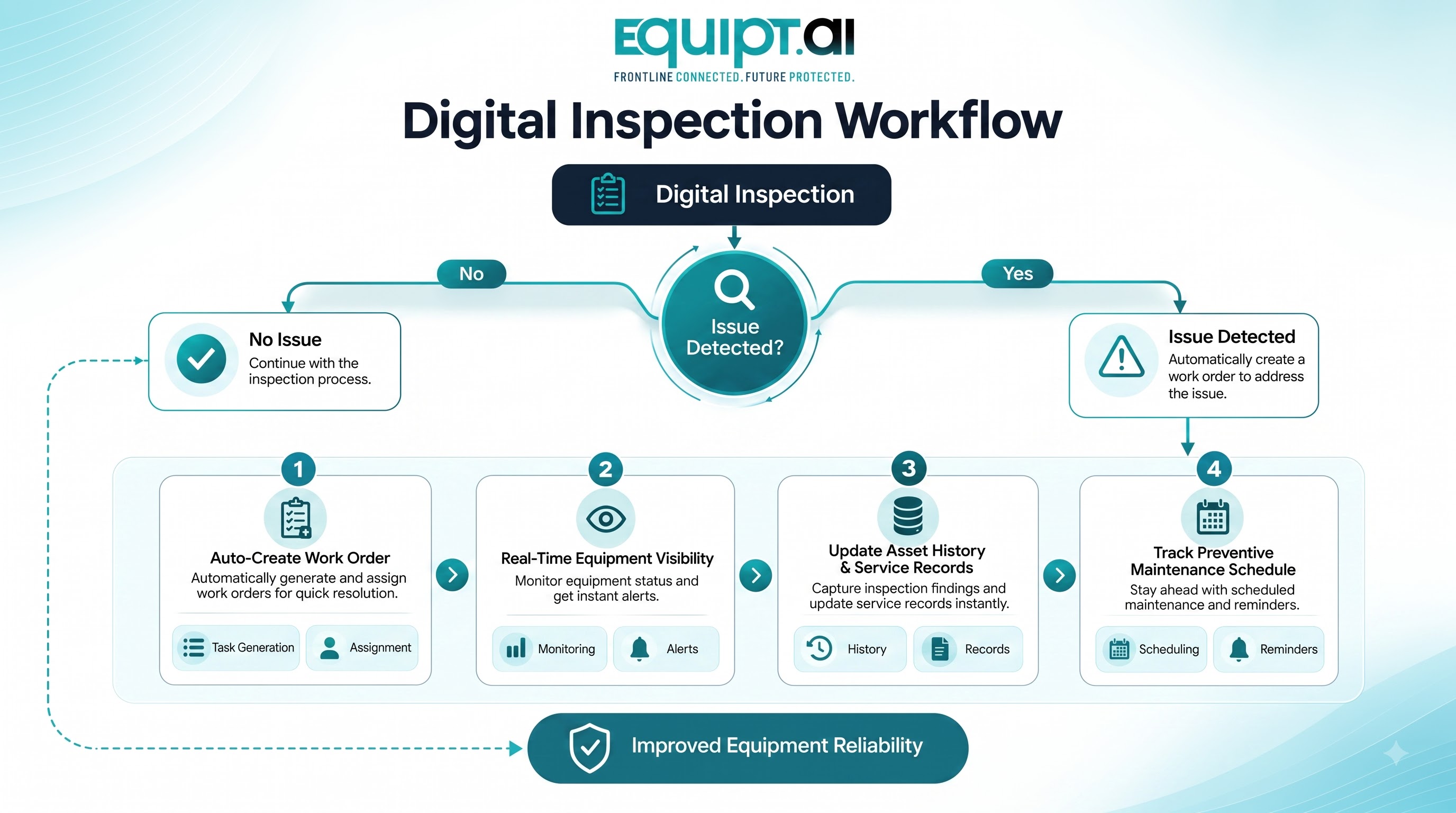
With Equipt.ai, organizations can:
Standardize digital inspection checklists across every field location.
Automate preventive maintenance schedules and work order management.
Maintain complete equipment history and service records for every asset.
Enable mobile inspections for field technicians, even in remote locations.
Improve technician scheduling and workforce utilization.
Monitor maintenance of KPIs through real-time dashboards.
Gain complete visibility into assets with intelligent asset tracking.
As an integrated oil and gas software platform, Equipt.ai combines oil and gas asset management software, oil and gas data management software, intelligent technician scheduling, and field service management software into a single solution. This helps maintenance teams reduce downtime, improve compliance and maximize equipment performance across all sites.
Wrapping Up
At its core, effective oilfield equipment maintenance comes down to one thing: consistency. When field teams follow a structured oilfield equipment maintenance checklist, they catch issues early, cut equipment downtime and keep critical assets running safely at every site.
As operations scale up, Equipt.ai is here to make that consistency a lot easier to pull off. It helps standardize inspections, automate work orders and give you real-time visibility into equipment health, no more chasing paper trails or guessing what's overdue.
Book a demo with Equipt.ai today and see how you can automate operational workflows at your site.
Frequently Asked Questions
1. What is an oilfield equipment maintenance checklist?
It's basically a list of inspections and tasks that keep your equipment safe, reliable and ready to work whenever you need it.
2. How often should oilfield equipment be inspected?
Check equipment every day, after every job and again at regular scheduled intervals. This exercise keeps breakdowns away and increases the lifespan of your equipment.
3. How can I reduce equipment downtime in oilfield operations?
You can do so by following the inspection checklist and by not skipping preventive maintenance and fixing small issues before they turn into big ones.
4. How can Equipt.ai simplify oilfield equipment maintenance?
Equipt.ai takes your inspections digitally, automates your workflow, keeps a full history of your equipment and makes it easy to stay ahead on preventive maintenance.
5. How can I switch to Equipt.ai for oilfield equipment maintenance?
Just book a demo, and the team walks you through digitizing your inspections, moving over your maintenance records and setting up a smoother workflow.

Aman Kaur
About the author
Dr. Hon. Amanpreet Kaur is the Co-Founder, CTO, and Chief AI Officer at Equipt.ai, where she builds operational AI for energy, industrial equipment, field teams, and critical infrastructure. With over 14 years of experience in enterprise technology and industrial operations, she writes about operational AI, digital twins, predictive maintenance, and enterprise-scale transformation.