Why Returned Equipment Sits Idle and How Rental Teams Can Speed Up Turnaround
Learn why returned rental equipment sits idle and how rental teams can reduce delays, improve inspections, and get assets back into service faster.
- Equipment Management
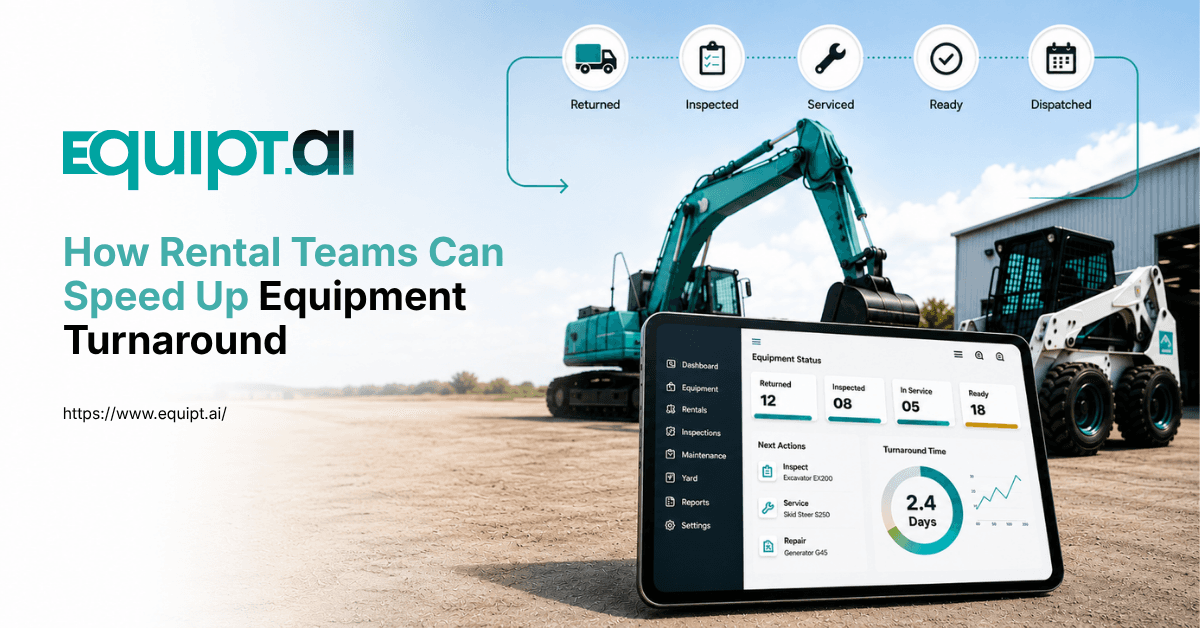
Brief:
Returned equipment is not always ready to rent again.
Inspections, maintenance and repairs can keep equipment idle.
Every hour equipment sits idle is a lost earning opportunity.
Rental companies have billions invested in their equipment fleets.
Disconnected teams can slow down the return-to-rent process.
Faster inspections can get equipment back into service sooner.
Rental teams need visibility into what is holding each asset back.
Return-to-rent time is an important operational metric.
Connected workflows can reduce delays across rental, service, and yard teams.
The goal is simple: get equipment back, get it ready and get it earning again.
When a piece of equipment comes back from a rental, the rental itself may be over, but the equipment is not necessarily ready for the next customer.
The machine may need to be inspected, cleaned and serviced for its next rental. Until those steps are completed, the equipment remains in the yard instead of generating revenue.
For rental businesses, this gap between returned and ready-to-rent can have a direct impact on fleet utilization and profitability.
The opportunity is significant because rental companies have substantial capital invested in their fleets. The American Rental Association estimates that its members own approximately $213 billion worth of equipment at original equipment cost, while the industry invested about $21 billion in new equipment in 2024 alone. [American Rental Association]
When that much capital is tied up in equipment, every unnecessary hour of idle time matters and it significantly affects your bottom-line.
Why Does Returned Equipment Sit Idle?
The equipment return process usually involves several SOPs and multiple teams. The equipment needs to be checked, its condition needs to be assessed, any problems need to be resolved and its status needs to be updated before it can be offered to another customer.
When these steps are disconnected, delays can quickly add up.
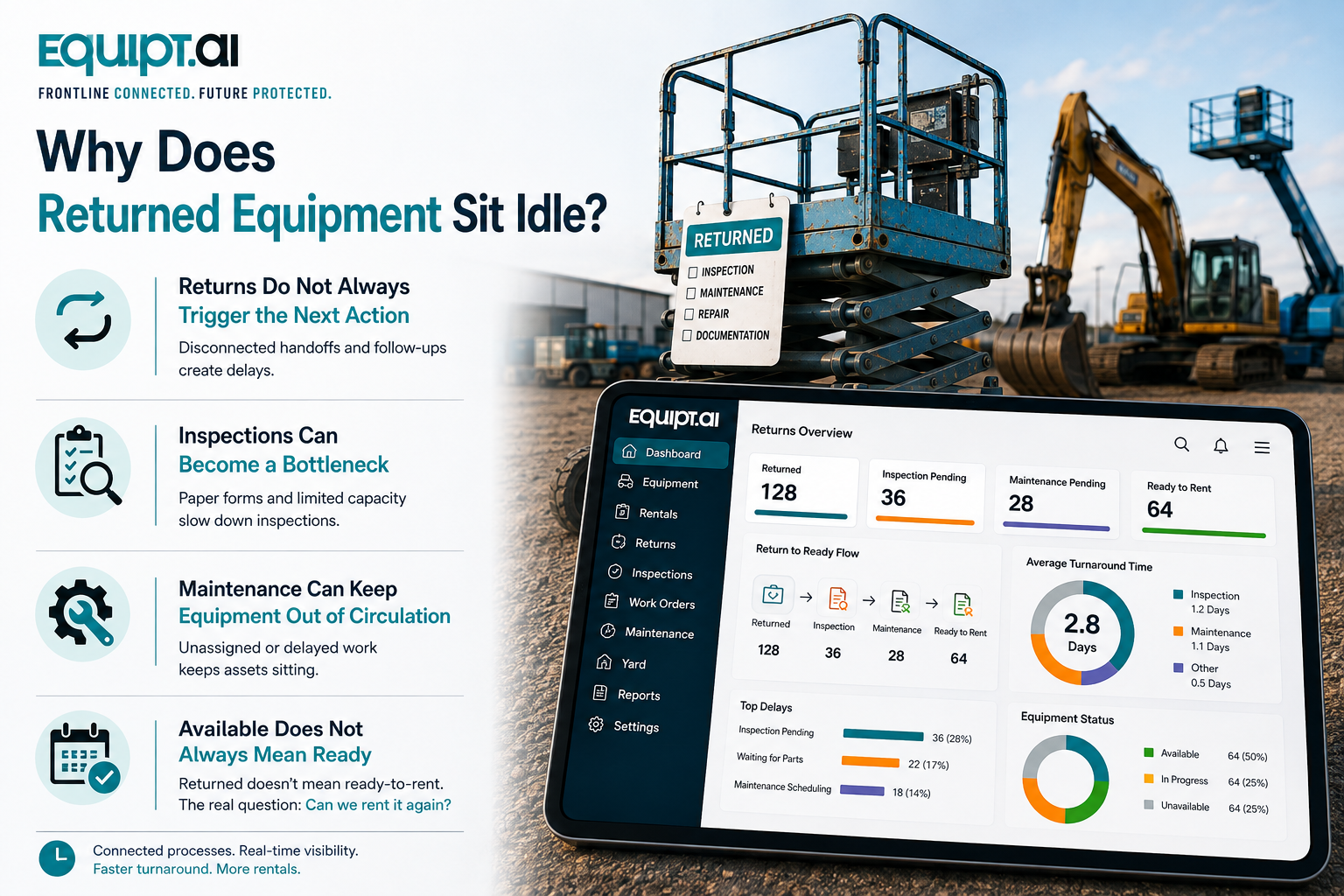
Returns Do Not Always Trigger the Next Action
When equipment comes back, the team needs to know what should happen next. Someone may need to inspect it, auditor may need to assess damage and the service team may need to carry out maintenance or repairs.
If these tasks are managed through disconnected systems: phone calls, messages, spreadsheets or manual follow-ups, returned equipment can sit idle while teams coordinate the work.
A return should therefore do more than closing a rental. It should automatically start the process of getting the equipment ready for its next dispatch.
Inspections Can Become a Bottleneck
A rental equipment inspection helps the team determine whether an asset is safe and suitable for another customer. However, the inspection itself can become a source of delay when teams rely on paper forms, manual data entry, WhatsApp messages or limited inspection capacity.
IPAF’s 2026 Rental Market Report offers a useful snapshot of just one segment of the rental industry. It found that the US MEWP (Mobile Elevating Work Platform) rental market reached around $15.8 billion in 2025, with a fleet of approximately 875,000 units and utilization at 70%. While these figures cover only powered access equipment, they give us a glimpse of the larger challenge rental companies face as their fleets grow. [IPAF]
Digital inspection workflows can help teams record equipment condition, photographs, meter readings and damage when the equipment is returned. More importantly, that information should immediately lead to the next action.
Maintenance Can Keep Equipment Out of Circulation
Returned equipment does not always require a major repair. Sometimes, it only needs routine servicing, a small fix, or preventive maintenance.
However, even a small maintenance job can keep equipment out of use when there is no clear process for assigning and completing the work.
The equipment may be sitting at the branch, but the rental team cannot offer it to the next customer until the work is done. This is where connected field service management software can help teams assign work, track repairs and get equipment ready for their next rental.
The same approach is important in oil and gas, where oil and gas software can help teams keep track of assets, maintenance and service requirements.
Available Does Not Always Mean Ready
This is an important distinction in equipment rental management. An asset can be back at the branch and appear as available in the system while still waiting for an inspection, maintenance, documentation or damage resolution.
Rental teams therefore need to know more than whether an asset has been returned. They need to know whether it is actually ready-to-rent.
The important question is not simply, “Has the equipment come back?”
It is, “Can we rent it again?”
This makes the inspection process an important part of improving equipment rental TAT (turnaround time). With the right software for equipment rental companies like Equipt.ai teams can make inspection information available to the people who need to act on it.
Why Return-to-Rent Time Matters
Return-to-rent is the time between equipment being returned and being ready for the next rental. The longer it takes, the longer the equipment stays idle.
Across a large fleet, these delays can quickly add up. Software for equipment rental companies can help teams see where time is being lost and get equipment ready faster.
How Rental Teams Can Improve Equipment Rental Turnaround
Here are some ways rental companies can speed up equipment turnaround:
Connect the Entire Process After the Return
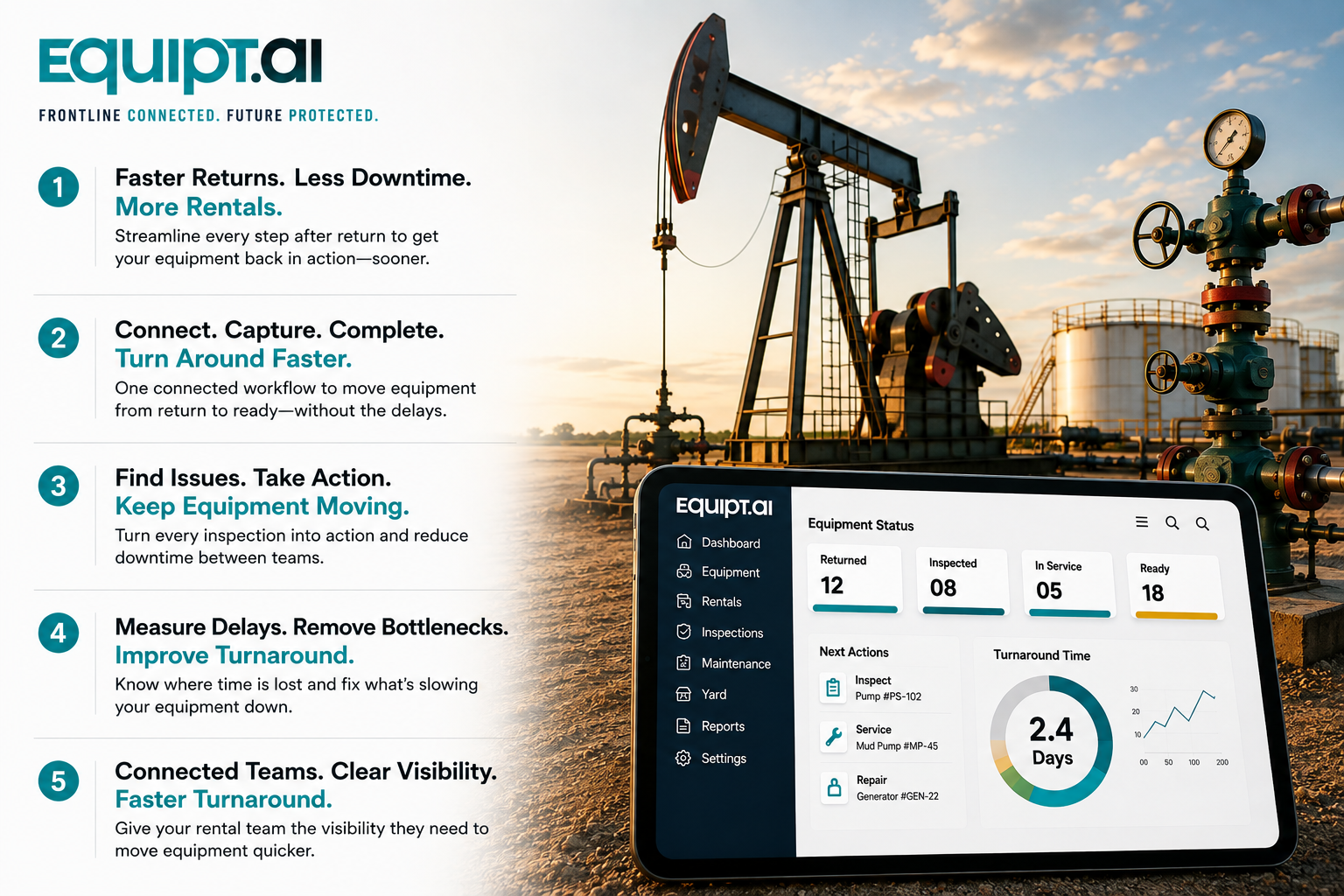
Efficient rental operations do not treat returns, inspections, maintenance and dispatch as completely separate activities.
Instead, the process should move naturally from one stage to the next. When equipment is returned, its condition should be recorded, any issues should be identified and the required work should be assigned. The equipment should then be cleared for its next rental as soon as the work is complete.
A connected workflow also makes it easier to see where an asset is waiting and who needs to take the next action. For rental businesses, software for equipment rental companies can help bring these steps into one connected workflow, so teams can see what needs to happen next.
Capture Information When the Equipment Returns
Teams should not have to enter the same information multiple times. A good equipment rental management system must allow teams to record equipment condition, photographs, meter readings, damage, and inspection results during the return process. The same information can then be accessed by the rental, yard, and service teams.
This reduces manual coordination and gives everyone the information they need to move the equipment forward. It is one of the practical advantages of using software for equipment rental companies instead of managing returns through disconnected tools. Explore Equipt’s equipment rental management software – Book a demo.
Turn Every Issue into an Action
An inspection should not simply create a record of the equipment's condition. If the inspection identifies a problem, the system should help the team act on it.
A repair requirement can create a work order, while a maintenance requirement can be assigned to the appropriate service team. If an issue has not been resolved, the equipment should remain unavailable until it is cleared.
This is where rental workflow automation can reduce unnecessary waiting between teams. Good software for equipment rental companies should make it easier to move from identifying a problem to assigning and completing the required work.
Equipt.ai can go beyond simply managing workflows. It learns from how your teams work, continuously optimizes workflows, and can take action on its own to keep equipment moving and reduce delays.
Measure Where the Time is Being Lost
Rental teams can improve turnaround more effectively when they understand where delays occur. They can measure the time between the return and inspection, the inspection and repair, the completion of work and the equipment becoming ready-to-rent, and finally the equipment becoming available for dispatch.
This makes it easier to identify the real bottleneck. If equipment spends several hours waiting for an inspection but only a short time being repaired, increasing maintenance capacity will not solve the problem. The inspection process needs attention instead.
A good software for equipment rental companies' platforms can help teams see these stages and identify where equipment is spending the most time waiting.
Faster Turnaround Means More from the Fleet You Already Have
Improving equipment rental turnaround is not only about making operations more efficient. It is about getting equipment back into service faster and getting more value from the fleet you already have.
The same applies to other asset-heavy industries, such as oil and gas, where keeping track of asset condition, maintenance, availability and field operations is critical. Equipt's oil and gas asset management capabilities can help businesses manage these requirements across their operations.
For rental companies, reducing idle time starts with reducing the time equipment spends waiting for inspection, maintenance, approval, or its next assignment. That is where equipment rental management software can make a difference.
By connecting returns, inspections, maintenance, and dispatch, Equipt.ai helps teams keep equipment moving. It learns from your workflows, optimizes them, and takes action when needed. The goal is simple: get equipment back, get it ready, and get it earning again.
Frequently Asked Questions
1. What causes returned rental equipment to sit idle?
Returned equipment can sit idle while it waits for inspection, maintenance, repairs or approval. When teams work separately, these delays can add up. Software for equipment rental companies connects these processes and helps teams know what to do next.
2. What is return-to-rent time?
Return-to-rent time is the period between an equipment return and the point at which the equipment is ready for its next rental. Reducing this period can help rental businesses improve equipment utilization.
3. How can rental companies reduce equipment rental turnaround time?
Rental companies can reduce turnaround time by connecting returns, inspections, maintenance, and dispatch in a single workflow. Software for equipment rental companies (Equipt.ai) can support this process by giving teams visibility into equipment status, automated task assignments, and bottlenecks.
4. How does equipment rental management software improve turnaround?
Equipment rental management software can give rental, service teams a shared view of equipment status and the work required after a return. This can reduce manual coordination and help teams move equipment back into service faster.
5. How can rental companies improve equipment utilization?
Rental companies can improve equipment utilization by reducing the amount of time assets spend waiting between rentals. Software for equipment rental companies can help teams measure return-to-rent time, reduce inspection and maintenance delays, and improve visibility across the fleet.

Aman Kaur
About the author
Dr. Hon. Amanpreet Kaur is the Co-Founder, CTO, and Chief AI Officer at Equipt.ai, where she builds operational AI for energy, industrial equipment, field teams, and critical infrastructure. With over 14 years of experience in enterprise technology and industrial operations, she writes about operational AI, digital twins, predictive maintenance, and enterprise-scale transformation.