How E-Genie Helps Field, Rental, Maintenance, and Operations Teams Work Faster
See how E-Genie helps field, rental, maintenance, and operations teams access answers faster and reduce time spent searching across systems.
- Artificial Intelligence
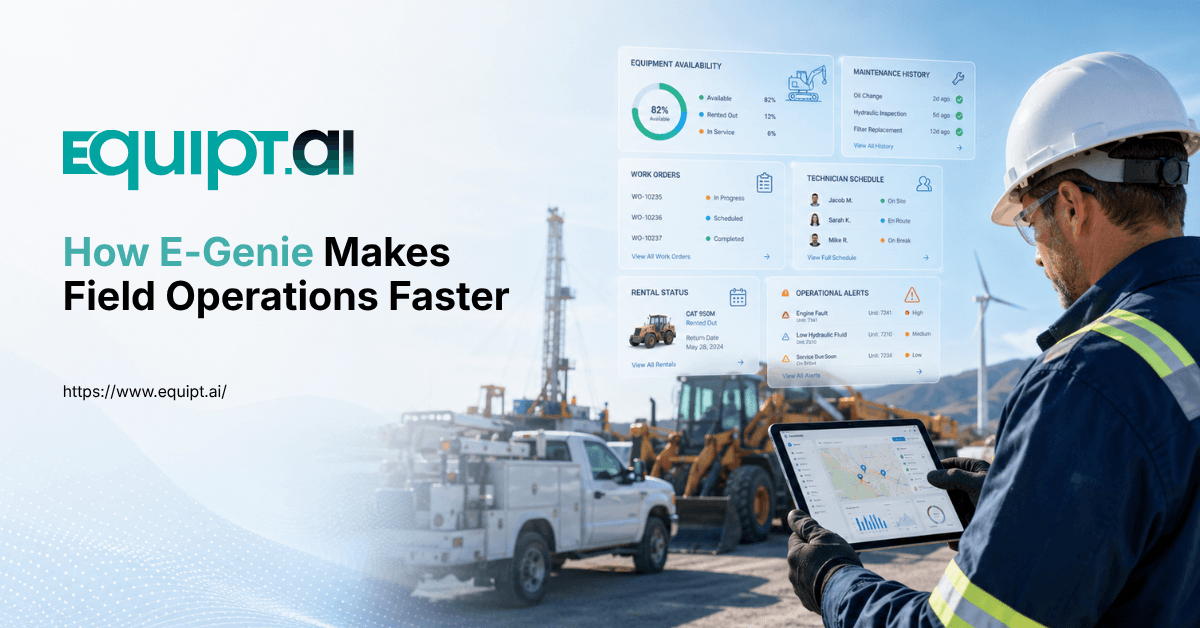
Field operations generate an enormous amount of information every day. Technicians update work orders, dispatchers adjust schedules, rental teams track equipment availability, maintenance teams review service history, and operations managers monitor jobs across multiple locations.
The challenge is rarely a lack of data. The bigger problem is finding the right information quickly enough to act on it.
Important details may be spread across equipment records, work orders, rental contracts, inventory systems, maintenance histories, technician notes, and operational reports. Employees often spend valuable time searching through systems, calling another department, or waiting for someone to confirm the latest status.
An AI assistant for equipment management can change how teams interact with this operational information. E-Genie, Equipt.ai's AI assistant, helps employees access operational data through natural-language questions and use those answers to make faster decisions across field service, equipment rental, maintenance, and day-to-day operations.
This is where AI in field service becomes especially useful. Instead of asking employees to navigate multiple screens and reports, AI can help bring relevant operational information closer to the point where work is actually happening.
Turning Operational Data Into Immediate Answers
Field technicians can lose a significant part of their week to administrative work and information searches. Salesforce research found that mobile workers spend about 18% of their working hours, or more than seven hours per week, on administrative tasks such as filling out forms and hunting for information rather than solving customer problems. This highlights why giving technicians faster access to work orders, equipment history, parts information, and service knowledge can have a direct impact on field productivity.
Traditional equipment management systems typically require employees to know where information is stored.
A dispatcher may need to open a scheduling dashboard. A maintenance manager may need to review equipment history. A rental coordinator might check contracts and availability, while an operations manager may pull several reports to understand what is happening across jobs.
An AI assistant for equipment management provides a different way to access this information.
Employees can ask questions such as:
Which equipment is available near this job?
Which assets are currently under maintenance?
Which rentals are due back this week?
Which work orders are delayed?
What equipment has been idle for more than seven days?
Which parts are required for an upcoming repair?
Which technicians are available for a new service request?
Instead of manually searching through operational records, teams can receive relevant information faster and move directly toward the next action.
For companies already using field service management software, an AI layer can make the information inside those systems easier to access without forcing employees to work through multiple dashboards for every question.
Helping Field Teams Get Answers Without Calling the Office
Field technicians frequently need information while they are already working on a job.
They may need to understand an asset's service history, confirm previous repairs, check whether a replacement part is available, or review instructions related to a work order.
Without easy access to this information, technicians often call dispatchers, supervisors, or maintenance coordinators for assistance.
E-Genie helps bring that operational knowledge closer to the field.
A technician could ask:
"What repairs were previously performed on this compressor?"
"Are there any open work orders for this asset?"
"Do we have the required replacement part in inventory?"
"What was the issue reported during the previous service?"
The AI assistant can use available operational information to provide useful context without requiring the technician to manually search through lengthy records.
This becomes even more valuable for organizations trying to schedule field technicians remotely across multiple jobs or locations. When field information, technician availability, and asset history are easier to access, dispatchers and technicians can coordinate work with fewer calls and delays.
Giving Rental Teams Faster Equipment Visibility
Equipment rental operations depend heavily on knowing where assets are, whether they are available, and what condition they are in.
When equipment information is difficult to access, rental teams may struggle to answer basic operational questions quickly.
Is the equipment available?
Has it been returned?
Is it ready for another customer?
Is it currently undergoing maintenance?
Could another branch transfer equipment instead of renting or purchasing an additional unit?
An AI assistant for equipment management can help rental employees answer these questions in seconds.
For example, a rental coordinator receiving a customer request could ask which units match the required equipment type and which locations currently have them available.
Teams could also identify overdue rentals, upcoming returns, idle assets, or equipment waiting for inspection.
For businesses using equipment rental management software, E-Genie can make rental information more conversational and easier to act on. Instead of searching through individual records, users can quickly understand availability, location, rental status, and maintenance readiness across the fleet.
This visibility can help rental companies improve utilization and reduce unnecessary rentals or equipment purchases.
Supporting Maintenance Teams With an AI Maintenance Assistant
Maintenance teams often have some of the richest operational data within an organization.
Every inspection, repair, failure, replacement part, technician note, meter reading, and service event adds another piece to an asset's history.
But reviewing that information manually can take time.
An AI maintenance assistant can help maintenance teams make this information easier to use.
Before starting a repair, a maintenance manager might ask:
Has this equipment experienced the same issue before?
What repairs were completed during the previous service?
Which components have been replaced recently?
Which assets are approaching their next service interval?
Are the necessary spare parts available?
Which equipment has repeated maintenance issues?
E-Genie can help surface relevant information from existing equipment and maintenance records so teams can understand the situation faster.
The AI maintenance assistant can also help technicians interpret lengthy service histories by summarizing previous activity rather than requiring employees to read through every individual work order.
Over time, better access to equipment history can also support a move from reactive repairs toward proactive maintenance. Instead of waiting for equipment to fail, teams can use maintenance history, recurring issues, service intervals, and other operational signals to identify assets that may require attention earlier.
Making Oil and Gas Equipment Information Easier to Use
In oil and gas operations, equipment, crews, maintenance activity, field tickets, and service records can be spread across multiple sites and systems.
This makes quick decision-making difficult when teams need to know where equipment is located, whether it is ready for use, what maintenance has been completed, or which jobs need attention.
Organizations using oil and gas software can use AI to make this operational information easier to search and interpret.
For asset-heavy operations in particular, oil and gas asset management software provides the underlying equipment records, maintenance histories, certifications, locations, and service activity that teams rely on.
E-Genie helps employees interact with that information more naturally.
An operations supervisor might ask which assets are currently unavailable. A maintenance manager could check which equipment has recurring issues. A field employee may need to confirm the latest inspection or certification before using an asset.
Instead of manually combining information from several records, teams can get to the relevant answer faster.
Helping Dispatchers Respond Faster to Changing Conditions
Dispatching is rarely static.
A technician can become unavailable. A job may take longer than expected. Equipment might fail before reaching the site. A customer could request emergency service.
Each change can affect the rest of the schedule.
E-Genie can help dispatchers quickly understand available options.
A dispatcher might ask:
"Which technicians are available near this location?"
"What jobs are currently running behind schedule?"
"Which technician has experience working on this equipment type?"
"Can this job be reassigned without affecting another appointment?"
Instead of manually comparing schedules, work orders, locations, and technician availability, teams can use AI to identify relevant operational information more quickly.
This helps dispatchers react to disruptions while keeping field teams productive and reducing the time spent coordinating routine updates.
Making Spare Parts Information Easier to Access
Parts availability can determine whether a maintenance job is completed in hours or delayed for days.
Technicians and maintenance coordinators frequently need to know whether a part is available, where it is stored, whether another location has stock, or whether it has already been allocated to another job.
An AI maintenance assistant can simplify these searches by making spare parts management information easier to access within the maintenance workflow.
A technician could ask whether a specific part is available for an asset and identify which warehouse or branch currently has it.
Maintenance teams could also review parts commonly associated with particular repairs, check stock across locations, or identify recurring component usage across equipment.
Making inventory information easier to access helps reduce time spent searching for parts and improves coordination between maintenance, inventory, and field operations.
Giving Operations Leaders a Clearer View of the Field
Operations managers face a different challenge.
They do not necessarily need every individual transaction. They need to understand what requires attention.
Which jobs are delayed?
Where is equipment sitting idle?
Which rentals are overdue?
What assets are repeatedly failing?
Where are technicians overloaded?
Which locations are experiencing operational bottlenecks?
An AI assistant for equipment management can make it easier for managers to explore these questions without waiting for someone to prepare a report.
Instead of reviewing multiple dashboards, leaders can ask operational questions directly and investigate areas that require attention.
This moves reporting away from simply describing what happened and toward helping teams understand what they should address next.
Moving From Answers Toward Action
The value of operational AI increases when it goes beyond answering questions.
If the system identifies an overdue rental, the next step might be contacting the customer.
If equipment requires maintenance, a work order may need to be created.
If a technician becomes unavailable, a job may need to be reassigned.
If a required part is stored at another branch, a transfer may need to be initiated.
As AI becomes more integrated into operational workflows, assistants can increasingly help teams move from identifying a situation to coordinating the appropriate next step.
E-Genie is designed around this idea: operational data should not remain buried inside reports and systems. It should help employees understand what is happening and act on it faster.
For field, rental, maintenance, and operations teams, that means less time searching for information and more time keeping jobs, equipment, and people moving.