10 Questions to Ask Before Buying Facility Maintenance Software
Choosing the right facility maintenance software requires more than comparing feature lists. These 10 questions help you evaluate usability, integrations, mobile access, reporting, scalability, and overall fit before making a decision.
- Field Service Management
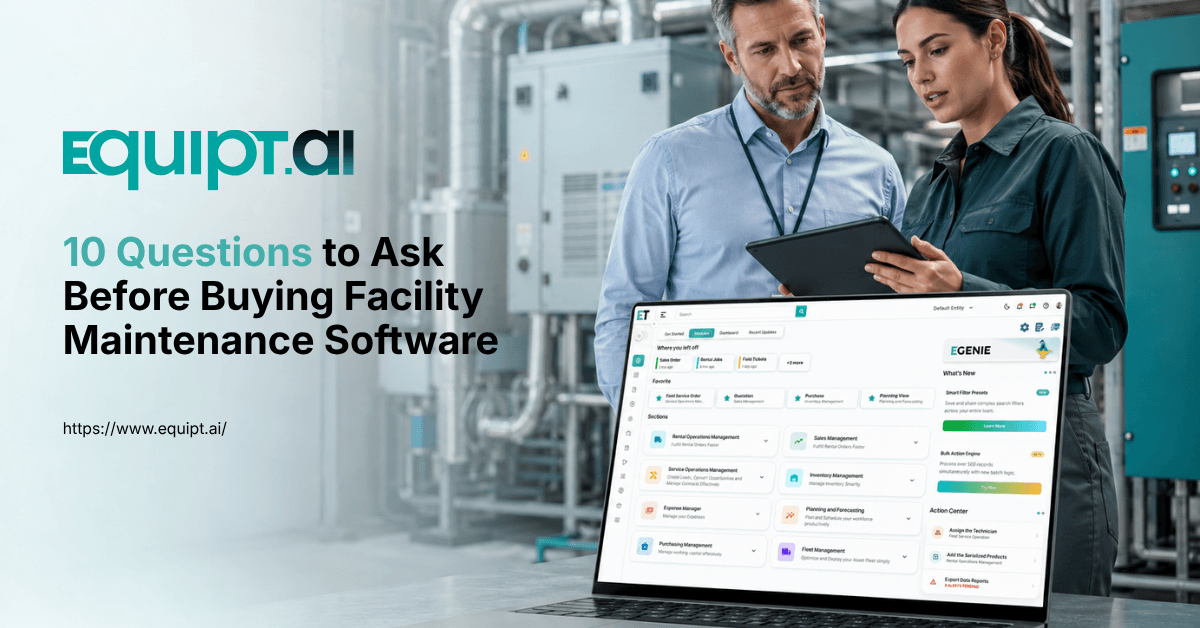
Overview:
Facility maintenance software should handle work orders from end to end.
Check if it can schedule preventive maintenance on its own.
It should track everything about your assets, not just the basics.
Your technicians need to use it from their phones, not just a desk.
Look for real inventory and spare parts tracking, not guesswork.
It should play nicely with the systems you're already using.
Reports should tell you something useful, not just list numbers.
It needs to grow with you, whether that's one site or fifty.
Ask how hard it is to actually get up and run.
Look past the price tag and figure out the real cost over time.
When you're ready to bring it all together, that's where Equipt.ai comes in.
Imagine a production line coming to a halt, and this is not because a critical machine failed unexpectedly, but because a preventive maintenance task was lost deep under a spreadsheet or a spare part wasn't reordered in time.
Trust us, these scenarios are more common than most maintenance teams would like to admit. That is why choosing the right facility maintenance software is no longer just an IT decision; it's now part of operational decisions too.
The right facility maintenance management system should eliminate such inefficiencies and not add to them. Therefore, we highly recommend that before comparing vendors or requesting demos, please ask these 10 critical questions to ensure you're investing in the right software for your business. Read the article until the end to be fully prepared.
How to Choose Facility Maintenance Software Without Any Regrets?
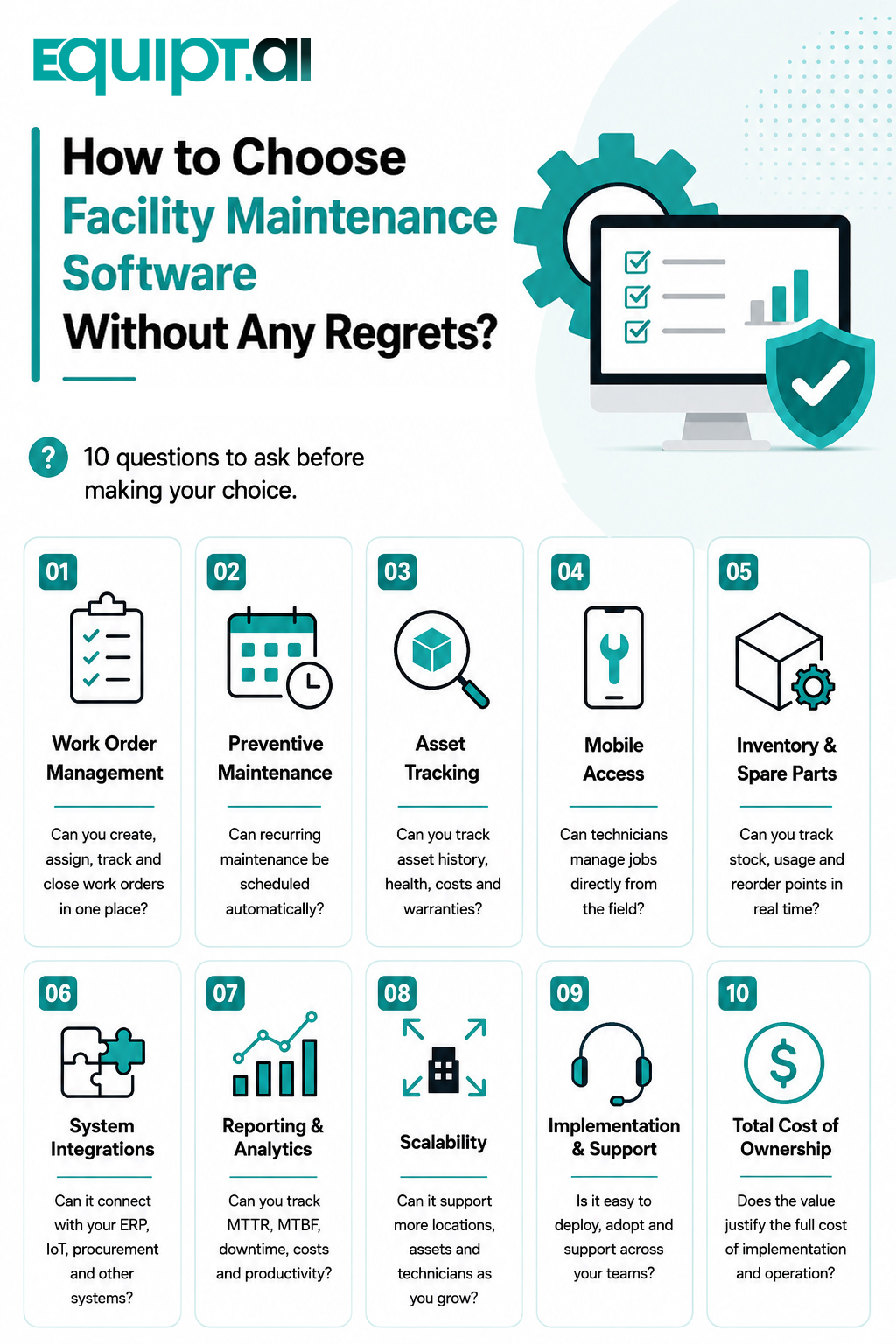
It’s very common to get distracted in the noise while searching for the best facility maintenance software for enterprises. However, the real value lies in how well the platform supports your day-to-day maintenance operations.
A well-equipped maintenance management software should simplify work order management, automate preventive maintenance, improve asset tracking, provide mobile access, integrate with existing systems (which is very important) and deliver complete insights. If your software still creates manual work, it solves the wrong problem.
It’s always better to start by submitting an enquiry to understand which solution best fits your specific needs. However, before finalizing a vendor, here are ten important questions you should ask to make sure you’re making the right choice:
1. Does the Software Simplify Work Order Management?
This brings us to the very first question.
Every maintenance job begins with a work order, so having the right software to manage that process sets out the foundation. A good field service management software should streamline maintenance requests from creation and assignment to tracking and closure, all from a single window.
When you're comparing options, pay heed to features like automatic assignment, priority levels, the functionality to attach photos, updates from technicians in the field, and real-time status tracking. These features matter because they cut down the time between spotting an issue and actually fixing it.
2. Does the Software Support Preventive Maintenance?
The cost of fixing equipment after it fails is always higher than maintaining it before it comes to a halt.
That's why your software should be capable of automatically scheduling recurring inspections, maintenance tasks and servicing based on parameters like time, usage, or meter readings. Doing this consistently helps you avoid unplanned downtime and extends equipment life.
This is also a good starter point for you to learn how Equipt.ai supports preventive and proactive maintenance. Let’s move to the next question.
3. Can It Track Every Asset Throughout Its Lifecycle?
Look, every asset has a history, and that history matters.
A well-built asset tracking software for facility managers should keep track of everything about your equipment, right from its maintenance history, service costs, warranty information, inspections, asset location, to current health. Features like QR code or barcode support further simplify these identification and maintenance tracking.
A complete asset visibility helps teams make better repair-or-replace decisions while improving long-term asset performance.
4. Can Technicians Access the Software Anywhere?
Maintenance doesn't happen behind a desk; it happens out on the floor and in the field. That's why frontline technicians need access to work orders wherever the work actually is, not just when they're back at a computer.
A good mobile maintenance software for technicians should come with functionalities like receiving work orders, uploading images, completing inspections, updating job status and recording parts used directly from a smartphone or tablet. Moreover, mobile access also reduces paperwork, improves communication, and keeps maintenance records accurate.
Let’s move to the next question.
5. Does It Include Inventory and Spare Parts Management?
One of the most common causes of delayed repairs is something surprisingly simple like a missing spare part.
That's why your maintenance software should come with inventory management features. It should track stock levels, reorder points and parts consumption in real time. That kind of visibility into inventory cuts unnecessary downtime, without tipping into the added cost of overstocking.
As someone looking to optimize inventory, you should also explore spare parts management strategies that combine maintenance history with inventory planning.
6. Can It Integrate with Your Existing Systems?
Maintenance doesn't operate in isolation.
Therefore, your facility maintenance software should integrate with your existing and legacy ERP systems, procurement platforms, IoT sensors, accounting software, and field service management software. A seamless integration would eliminate duplicate data entry and provide a complete operational view across departments. Equipt.ai does exactly the same, from scheduling field technicians across multiple locations to seamlessly integrating with existing systems; it makes your operations as smooth as texting on a messaging app.
Let’s move on to the next question.
7. Does It Provide Actionable Reports?
The reports your software fetches should do more than summarize work orders. You must look for equipment rental management software that tracks key performance indicators like MTTR (Mean Time to Repair), MTBF (Mean Time Between Failures), equipment downtime, preventive maintenance compliance, technician productivity and maintenance costs.
When you have insights like these, it's easier to spot recurring issues, plan in advance and make smarter decisions on your resource allocation.
8. Will the Platform Scale with Business Growth?
Your business has potential and ambitions to grow beyond boundaries and set new benchmarks. Your one-location facility today may become a global operation tomorrow.
It is wise to always choose scalable maintenance management software that supports multiple locations, addresses your growing team's demand, and gives you centralized reporting. It should also make it easy to schedule field technicians across multiple locations while balancing workloads and minimizing travel time.
Scalable software solutions like Equipt.ai grow along with your business and ensure your maintenance operations remain efficient as your business expands.
9. How Easy Is Implementation?
This is a very crucial point; the best product is good only if it is viable and easy to implement. Even the most advanced tools deliver little value if employees struggle to adopt them.
You must ask vendors about implementation timelines, data migration, onboarding, user training, and 24X7 support. The easier the platform is to use, the sooner your team starts seeing measurable results.
10. What Is the True Total Cost of Ownership?
Software pricing goes beyond subscription fees, and every manager knows this. Thus, you must consider points like implementation costs, integrations, training, ongoing support, upgrades, and scalability. More importantly, evaluate how much manual work the platform eliminates (this is your real ROI).
Understand CMMS (Computerized Maintenance Management System), EAM (Enterprise Asset Management) and FSM (Field Service Management)
The most common issue is that many organizations start comparing maintenance platforms without really understanding what each one is built for. Before you buy anything, it is important to know the difference between CMMS vs EAM vs FSM.
Well, here’s a quick explainer: a CMMS (Computerized Maintenance Management System) is all about maintenance scheduling and work orders. An EAM (Enterprise Asset Management) takes a broader view, managing an asset's entire lifecycle from purchase to retirement. An FSM (Field Service Management), on the other hand, is built for coordinating technicians, customer service, and field operations. Once you understand what each one actually does, it's much easier to invest in software that fits your goals.
And if your organization deals with both owned and rented equipment, there's one more piece worth considering. Read the next heading.
Bringing Everything Together with Equipt.ai
Frontline maintenance teams don't need another disconnected system; they need one connected platform.
Equipt.ai brings together work orders, assets, technicians, inspections, inventory, maintenance schedules and field activity into a single operational view.
Whether it's proactive maintenance, spare parts and field service management, multi-location scheduling, or choosing between CMMS, EAM, and FSM, Equipt.ai brings it all together, so your team can focus less on busy work and more on getting things done.
Frontline Connected. Future Protected.
In a Nutshell
Choosing the right maintenance software isn't just a purchase; it's an investment in how well your operations run. The best facility maintenance software doesn't just digitize maintenance; they also help you prevent failures, use resources wisely and make smarter decisions every day.
Ask the right questions to your vendor before your purchase decision. If you still have a query, feel free to write to marketing@equipt.ai.
Frequently Asked Questions
What is facility maintenance software?
A Facility maintenance software helps organizations bring everything into one place, from work orders and preventive maintenance to asset tracking, technician scheduling, inventory, inspections and reporting.
How do I choose the right facility maintenance software?
To choose the right facility maintenance software, look for strong work order management, preventive maintenance, asset tracking, mobile access, inventory management, system integrations, actionable reporting, scalability, easy implementation and low total cost of ownership.
Can facility maintenance software reduce downtime?
Yes. By automating preventive maintenance with Equipt.ai, improving asset visibility and ensuring technicians and spare parts are available when needed, organizations can significantly reduce unplanned downtime.
Is facility maintenance software the same as a CMMS?
Not always. Modern facility maintenance software often combines CMMS capabilities with asset management, analytics, inventory management, AI and field service functionality.