CMMS vs FSM Software vs EAM: Which System Fits Best?
Confused by CMMS vs FSM software and CMMS vs EAM? Use this practical guide to choose the right system for maintenance, assets, and field operations.
- Technology Trends
A lot of software decisions get framed as feature comparisons.
This one usually starts with frustration.
A maintenance lead is trying to control repeat breakdowns. An operations team is managing assets across multiple sites. A field service manager is juggling technicians, jobs, equipment, and customer expectations.
All three end up searching the same acronyms and getting the same vague answer: CMMS, EAM, FSM.
That is where the confusion starts.
Because the real question is not what these tools mean. It is when each one becomes necessary. And if you get that part wrong, you either buy something too narrow and outgrow it fast, or buy something too broad that adds complexity before you need it.
If you are comparing CMMS vs FSM software or trying to make sense of CMMS vs EAM, think less about what and more about where work is breaking down in your operation today.
Why Does This Decision Get Confusing Faster Than It Should?
These categories overlap just enough to make buyers second-guess themselves.
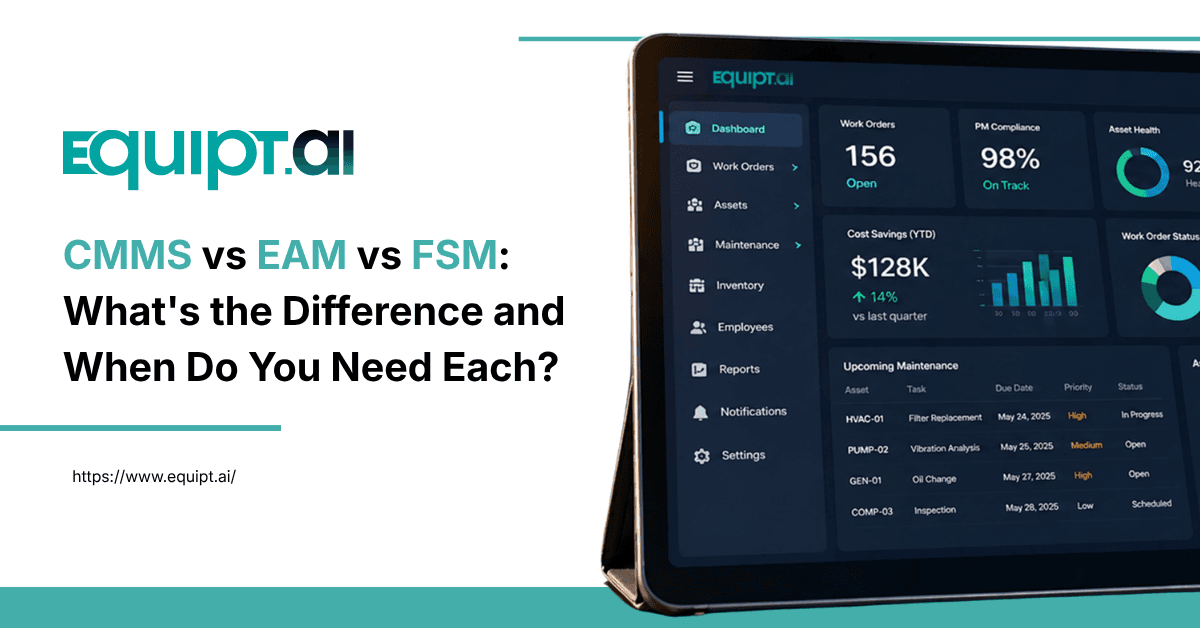
A CMMS handles work orders, maintenance scheduling, and asset records.
EAM goes wider, covering the full lifecycle of physical assets from acquisition through maintenance to disposal.
FSM focuses on deploying and coordinating field personnel, jobs, schedules, and service execution outside the facility.
In other words, they can all touch work orders, but they are not built to solve the same operating problem.
That overlap is why so many teams pick based on a demo checklist instead of operational fit.
If your main issue is preventive maintenance slipping, a CMMS may be enough.
If your issue is asset performance across locations, replacement timing, and capital planning, you are already thinking beyond CMMS.
If your issue is that jobs, technicians, equipment, and customer commitments all move in real time, that is a different class of problem again.
A useful way to think about it is this:
CMMS helps you manage maintenance work.
EAM helps you manage the business value of assets across their lifecycle.
FSM helps you manage service execution in the field.
Did you know?
The global computerized maintenance management system market is projected to grow from USD 1.62 billion in 2026 to USD 3.82 billion by 2034. That is a strong signal that more operations teams are moving away from spreadsheets and reactive maintenance into structured maintenance systems earlier than before.
CMMS Solves Maintenance Control, Not Operational Sprawl
CMMS is usually the first serious system teams need when maintenance is still being managed through spreadsheets, paper logs, tribal knowledge, or disconnected work requests.
Its job is straightforward: bring structure to maintenance operations.
That means centralizing work orders, standardizing preventive maintenance, keeping asset history in one place, and improving day-to-day maintenance workflows. A CMMS earns its keep on the small stuff too: every corrective maintenance job it records is a failure you can count later.
A CMMS is often the right fit when your world looks like this:
A plant or yard has recurring inspections, breakdowns, PM schedules, spare parts, and internal maintenance teams. The problem is not strategy. The problem is control. Work is being missed, history is incomplete, and no one fully trusts the maintenance picture.
The CMMS market is not just growing. It is growing at an estimated 11.3% CAGR through 2034, which suggests buyers increasingly see maintenance control as a foundational operational layer, not just a back-office tool.
In that environment, CMMS is a clear step up.
But this is also where many teams hit the first limit.
A CMMS is strong at maintenance control. It is not automatically built to answer broader questions like:
Which assets across sites are costing us the most over time?
When should we repair versus replace?
How do asset decisions affect lifecycle cost and capital planning?
How do we coordinate field execution once work no longer stays inside one facility? That execution gap is the subject of beyond traditional CMMS software.
That is the point where CMMS vs EAM becomes a real discussion.
EAM Enters When Asset Decisions Become Bigger Than Maintenance
EAM usually shows up when the business is no longer managing maintenance in one operational pocket.
Now assets are spread across sites, business units, or service environments. Leadership needs a bigger view. Not just what broke, but what the asset is worth, what it is costing, how long it should stay in service, and where investment should go next.
That is the core distinction. A practical example helps.
Imagine a multi-site industrial operation with pumps, compressors, vehicles, and rotating equipment spread across yards and remote locations. Maintenance work orders are being completed.
But leaders still cannot answer bigger questions with confidence:
Which assets are draining the budget?
Which locations are carrying avoidable risk?
Which units should be overhauled, redeployed, or retired?
Where is maintenance spent improving reliability, and where is it just keeping weak assets alive?
That is not a CMMS-only problem anymore. Many teams answer the reliability part with reliability centered maintenance, which sets each asset's tasks by how it fails and what each failure costs.
It is an EAM problem.
This is especially true in sectors where uptime, compliance, and asset economics are tightly linked. In those environments, teams often start looking beyond maintenance records and toward systems closer to oil and gas asset management software, where lifecycle visibility matters as much as work completion.
EAM becomes useful when maintenance data alone is no longer enough to run the asset strategy.
FSM Becomes Critical When Work Leaves The Facility
Now let’s shift to a different kind of complexity.
Not every operation breaks because maintenance is poorly documented. Some break because work is moving outside the facility, and coordination falls apart in motion.
That is where FSM matters. For instance, an example would be;
A field service or rental operation has jobs happening across customer sites. Technicians are moving. Equipment availability changes. Priority jobs appear mid-day. Customers want updates. Dispatch needs to match skills, geography, and timing. In that environment, the bottleneck is not maintenance history. It is live coordination.
This is why CMMS vs FSM software for work order management is a trickier question than it looks.
Yes, both systems can involve work orders. But the role of the work order is different.
In CMMS, the work order is mainly a maintenance control tool.
In FSM, the work order is part of a live service workflow tied to scheduling, dispatch, field updates, and job completion.
That distinction shows up repeatedly across reference material. CMMS is maintenance-focused, while FSM is built to send people into the field and manage service delivery there.
Think about a rental or service business coordinating technicians, jobs, and assets across locations. A team like that may need more than maintenance planning. It may need workflows closer to equipment rental management software, where asset readiness and field execution affect revenue in real time.
And once scheduling becomes a daily source of friction, the problem is no longer just work order creation. It becomes a routing and coordination problem, which is why the right technician scheduling matters so much once service teams scale.
If work happens outside the facility, FSM stops being optional much faster than many teams expect.
CMMS vs EAM vs FSM: The Fastest Way To See The Difference
Here is the simple version.
CMMS is maintenance-first.
EAM is lifecycle-first.
FSM is field-execution-first.
Use the comparison below as a practical decision lens.
Category | CMMS | EAM | FSM |
Core purpose | Control maintenance work | Manage the full lifecycle and value of assets | Coordinate and execute work in the field |
Best-fit team | Internal maintenance teams | Asset-heavy multi-site operations and leadership teams | Field service, dispatch, mobile workforce, rental, and service operations |
Operating environment | Plants, facilities, shops, yards | Multi-site asset environments with strategic planning needs | Customer sites, remote locations, distributed service environments |
Main business problem solved | Missed PMs, reactive work, poor maintenance visibility | Weak lifecycle visibility, poor asset planning, and fragmented asset decisions | Scheduling chaos, poor dispatch, weak field visibility, and delayed job completion |
Where it starts breaking down | When asset strategy or field coordination becomes the bigger issue | When live field execution and service orchestration become the bottleneck | When the business also needs deeper lifecycle governance and capital planning |
When to move to the next layer | When maintenance is under control, but asset decisions are not | When an asset strategy exists, but execution in the field is fragmented | When field execution is strong but disconnected from the broader asset and maintenance strategy |
How To Tell What Your Team Actually Needs Next?
This is the part most comparison blogs skip.
You do not choose between CMMS, EAM, and FSM by asking which one is “better.” You choose by asking where operational friction is actually showing up.
You Likely Need CMMS First If…
Your maintenance team is still trying to standardize the basics.
Work orders are inconsistent. PMs are missed. Asset history lives in different places. Spare parts are hard to track. You are trying to reduce downtime, but the first problem is that maintenance itself is not organized enough yet. That is classic CMMS territory.
You Likely Need EAM If…
You already have maintenance data, but the harder decisions are now strategic.
You are managing multiple locations. Leadership needs lifecycle visibility. Costs, risk, condition, utilization, and replacement planning matter more than simply knowing whether a technician closed a work order. That is when CMMS vs EAM stops being theoretical and starts affecting budget and asset policy.
You Likely Need FSM If…
The operation wins or loses in the field.
A technician misses a slot. A crew gets sent without the right context. An equipment-ready job slips because dispatch and field updates are out of sync. Customers call for status. Revenue waits on job completion. That is not just a maintenance issue. It is a field execution issue, which is exactly where field service management software becomes a more relevant system layer.
You May Need a Connected Approach If…
Your operation does not fit neatly into one box anymore.
That is common in industrial services, energy, and rental-heavy environments.
For example:
A maintenance team in one facility may start with CMMS because recurring PM control is the priority.
A multi-site operator may move toward EAM when asset cost, condition, and replacement planning become leadership questions.
A service business may need FSM once technicians, equipment, SLAs, and jobs must be coordinated live across locations.
An oil and gas operation may need all three perspectives at once: maintenance discipline, asset visibility, and field execution, especially across remote sites and mobile crews.
That is where a capable oil and gas software like Equipt.ai starts to make more sense. In those environments, the need is not just better maintenance records or better dispatch. It is keeping asset tracking, field scheduling, preventive maintenance, compliance, and field-to-office coordination connected as one operating flow.
Where Equipt.ai Fits When Teams Are Tired of Disconnected Tools?
By the time a team is seriously comparing CMMS, EAM, and FSM, the real problem is usually no longer software categories. It is operational disconnect.
Maintenance runs in one system. Asset visibility sits somewhere else. Field execution depends on calls, workarounds, and updates that arrive too late.
That is where Equipt.ai becomes relevant.
Instead of treating maintenance, asset tracking, rental coordination, and field execution as separate workflows, Equipt.ai brings them closer to the operating moment, where teams need to know what is available, what needs service, what can move, and what happens next.
That matters more in businesses where work does not stay neatly inside one facility.
A field-heavy operator may need service workflows and mobile execution.
A rental business may need live equipment visibility, scheduling, and billing continuity.
An oil and gas team may need asset readiness, compliance, and field coordination to stay connected.
Equipt.ai’s solutions are about real-time visibility, operational coordination, and workflows that connect field crews, operations, and the back office in one place.
So if CMMS helps you control maintenance, EAM helps you think more strategically about assets, and FSM helps you run work in the field, Equipt.ai fits the teams that are tired of managing those realities in separate systems.
How to Choose Without Over complicating It?
The CMMS vs FSM software decision is not really about categories. It is about what your operation needs to run better next.
If maintenance control is the issue, CMMS is the right start.
If asset performance and lifecycle decisions are getting bigger, EAM matters.
If work is moving across technicians, sites, and live service conditions, FSM becomes essential.
And if all three are now colliding in one operation, the real question is simple, are your systems helping work move forward, or forcing your team to connect the dots manually?
Equipt.ai gives teams the visibility and control to keep work moving across maintenance, asset readiness, and field service, without breaking the workflow across separate systems.
Book a 20-minute walkthrough and we’ll show you where work orders stall, where dispatch loses time, and where field updates are turning into revenue delays!
FAQs
1) What Is the Main Difference Between CMMS and FSM software?
The main difference is operational focus. CMMS is built to organize maintenance work such as work orders, PM schedules, labor, and asset history. FSM is built to deploy and coordinate field personnel, jobs, schedules, and service delivery outside the facility.
2) Is CMMS Vs FSM Software for Work Order Management Really a Fair Comparison?
Only partly. Both can involve work orders, but they use them differently. CMMS uses work orders mainly to control maintenance activity. FSM uses work orders as part of a live service workflow that includes dispatch, scheduling, technician updates, and field completion.
3) How Should I Compare FSM Vs CMMS for Maintenance Teams?
Start with where the team works. If the team is mainly maintaining internal assets in a facility, CMMS is often the better fit. If the team is mobile, handling jobs across customer or remote sites, FSM becomes more important because scheduling and field coordination are central to performance.
4) Is CMMS Enough for a Maintenance Team?
Often yes, at first. If your main challenge is preventive maintenance, work order consistency, and asset maintenance records, CMMS can be enough. It stops being enough when leadership needs deeper lifecycle planning or when work execution depends on field coordination outside the facility.
5) What Is the Real Difference Between CMMS and EAM?
CMMS focuses on maintenance operations. EAM covers the broader lifecycle of assets, including decisions that stretch from acquisition to disposal. Put simply, CMMS helps run maintenance better, while EAM helps manage the long-term value and performance of assets more strategically.
6) When Does EAM Become Necessary?
EAM becomes more necessary when your business is managing assets across multiple sites, needs stronger lifecycle visibility, or must make better decisions about cost, condition, utilization, and replacement planning. That is usually the point where maintenance data alone is no longer enough.
7) Can One Platform Support Maintenance, Asset Management, and Field Operations Together?
Yes, some platforms aim to connect those layers rather than keep them separate. This becomes especially relevant in asset-heavy industries where maintenance, asset visibility, and field execution constantly affect one another.