Strategies to Schedule Field Technicians Across Multiple Locations Without Delays
Eliminate delays with efficient, multi-location field technician scheduling.
- Field Service Management

Imagine a situation where a customer has been waiting for hours, your technician is stuck across town, and your support team is overwhelmed with complaints. Does this sound familiar? Well, many businesses face this challenge when trying to manage field technicians in different locations.
Scheduling field service technicians can often feel like a complicated game of Tetris. You’re always trying to fit pieces together just right, but one wrong move can cause confusion.
Especially when you are managing technicians across multiple locations, even small inefficiencies add up. Distance, overlapping jobs, and last-minute changes often make scheduling feel like a constant uphill battle. But it doesn’t have to be this way. In this blog, we’ll explore practical field service scheduling strategies that can simplify technician scheduling, reduce delays, and give your business the competitive edge it needs.
Technician scheduling is the process of assigning field technicians to jobs by skill, location and availability, then keeping that plan current as cancellations, emergencies and delays come in. Across multiple locations it also means balancing workload between regions and keeping travel between sites as short as possible.
Why Scheduling Field Technicians Across Multiple Locations Is Challenging?
Managing technicians across different locations may sound simple on paper. But in reality, it requires a constant balance of management, oversight and field service schedule. Here’s why it gets so challenging:
Last-minute cancellations or emergencies: A sudden sick day, an urgent customer call, or an unexpected breakdown calling for immediate incident management can turn your entire schedule off track.
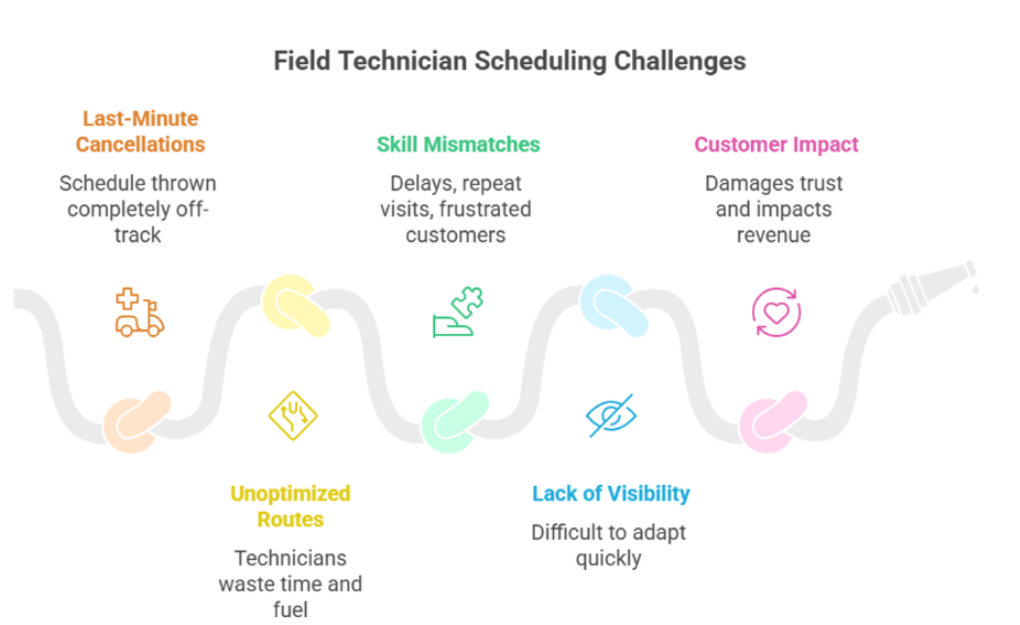
Unoptimized travel routes: Without smart routing, technicians spend more time on the road than at job sites. This can waste both time and fuel.
Skill mismatches: Sending the wrong technician for a complex job causes delays, requires repeat visits, and frustrates customers.
Lack of real-time visibility: Relying on spreadsheets or manual scheduling leaves you unaware of what’s happening on the ground. This could make it difficult to adapt quickly.
Customer impact: Every missed appointment or delayed visit damages customer trust and directly affects your revenue.
The real cost of poor scheduling goes far beyond inefficiency. When left unaddressed, these challenges ripple across the business, impacting both customer satisfaction and revenue.
The Business Impact of Poor Scheduling
When field technician schedules fall apart, it affects your entire business. You may face higher costs and unhappy customers. Here’s what poor scheduling means in the field:
Higher operational costs: When technicians travel between job sites using inefficient routes, fuel and travel costs increase significantly. If jobs run over time due to gaps in scheduling, overtime expenses add up, hurting profits directly. In fact, inefficient routing can increase operational costs by 10-30%. This is why businesses today are investing in technician scheduling software and field service planning tools to reduce reactive costs.
Missed SLAs (service level agreements): In industries like utilities, telecom, or equipment servicing, meeting SLAs is non-negotiable. A late technician or missed appointment can mean hefty penalties, strained contracts, and even lost business opportunities.
Declining customer trust and retention: Customers want technicians to arrive on time and fix the problem during the first visit. Poor scheduling can lead to long wait times or sending the wrong technician, which can harm trust. Research shows that 70% of customers are less likely to stay loyal after two or more bad service experiences.
Technician burnout and dissatisfaction: Constantly shifting schedules, long travel times, and unrealistic workloads lead to burnout. For field teams, that means low morale, higher turnover, and increased training costs to bring in new technicians.
Strategies to Schedule Field Technicians Without Delays
With the right strategies, you can take control of scheduling and consistently deliver services on time. Here’s how:
1. Implement Smart Scheduling Software for Technician Dispatch
Manual scheduling often leaves managers guessing. Smart scheduling tools powered by AI take the guesswork out by automatically assigning the right technician to the right job.
AI-powered matching: Assign jobs based on skills, location, and availability, reducing errors and mismatches.
Real-time updates: If there’s a cancellation or emergency, the system instantly reassigns tasks to keep operations running smoothly.
Our scheduling feature uses AI and automation to help businesses streamline technician allocation across multiple locations while reducing delays and improving first-time fix rates. Oilfield service crews add certifications, equipment readiness and hours-of-service limits to that match, which our guide to oilfield crew scheduling and dispatch walks through step by step.
2. Route Optimization using Location Intelligence
Unoptimized travel routes are one of the biggest reasons for wasted time. By using GPS and mapping tools, you can reduce travel delays and make better use of technician hours.
Faster travel times: Prioritize jobs based on proximity and traffic data to minimize commute times.
Lower costs: Minimize fuel expenses and vehicle wear and tear.
According to McKinsey, location intelligence can cut travel time by up to 15%, directly improving efficiency.
3. Match Skills with Job Requirements
Imagine sending a junior technician for a complex HVAC repair when the task actually requires a more skilled and experienced technician to do the job. Sending the wrong person leads to delays and repeated visits.
Create a skills inventory: Document technician expertise and certifications.
Smart job allocation: Ensure tasks are matched with the technician best equipped to handle them.
This approach saves time and also improves first-time fix rates, which boosts customer satisfaction.
4. Centralize Communication
Miscommunication is one of the top causes of delays. A centralized communication system keeps everyone aligned and informed. A technician field service scheduling app or field service dispatch software ensures updates reach the right person instantly.
Mobile apps for technicians: Get instant job updates, location changes, or emergency tasks on the go.
Less back-and-forth: Reduce time wasted in calls and messages.
With Equipt.ai, technicians receive automated alerts and updates on a single platform, ensuring no job slips through the cracks.
5. Predictive Scheduling with Historical Data
Your past service data holds valuable insights. By analyzing it, you can forecast demand and allocate resources more effectively. Industries like utilities and energy already leverage oilfield data management to improve scheduling accuracy and reduce downtime. Similarly, your business can use predictive analytics to anticipate peak demand and ensure seamless coverage.
Anticipate peak demand by using historical data to predict seasonal spikes or recurring service needs.
Forecast technician availability to prevent overlaps and ensure seamless coverage across regions.
Automated notifications help teams prepare in advance, reducing last-minute chaos.
Predictive scheduling effectively reduces delays and provides your business with a competitive advantage.
6. Customer Self-Scheduling Options
Customers value transparency and flexibility. AI-powered software solutions can offer self-scheduling options that build trust and cut down on no-shows.
Pick a time slot: Customers choose from available slots that fit their schedule.
Improve first-time fix rates: Transparency helps customers be prepared, leading to smoother service delivery.
Research shows that 67% of customers prefer self-service options because they provide convenience and control.
Pro Tip: Combine these strategies with advanced tools like an AI-powered scheduling solution, and you’ll have complete control over technician allocation, travel optimization, and customer satisfaction, all from one centralized platform.
How to Automate Technician Scheduling and Dispatch
Automating technician scheduling and dispatch means the system, not a coordinator, assigns each job and reacts when plans change. Five steps get you there:
Build a skills inventory: record each technician's expertise and certifications so the system knows who can take which job.
Set the assignment rules: match jobs by skills, location and availability, and decide which jobs take priority when two compete for the same technician.
Connect live job status: give the schedule real-time visibility into technician locations, job progress and delays, so a cancellation or emergency triggers reassignment automatically.
Send work to technicians' phones: deliver new jobs, location changes and emergency tasks through a mobile app instead of calls and messages.
Forecast demand: use past service data to predict seasonal spikes and technician availability by region, so coverage is planned before the rush.
How Artificial Intelligence Is Streamlining Field Scheduling Across Multiple Locations?
Coordinating field technicians across multiple sites used to mean juggling spreadsheets, making endless calls, and relying on guesswork. Today, technology is changing the entire game. It is giving business leaders more control, visibility, and efficiency than ever before. Let us check out how.
Real-Time Data Dashboards for Business Leaders
Instead of waiting for end-of-day reports, managers now get real-time visibility into technician locations, job progress, and delays. Dashboards highlight what’s working and what’s not. This helps leaders make data-based decisions faster. According to Gartner, organizations using real-time data improve operational efficiency by up to 20%.
AI-Driven Workforce Management
AI solution can help you match the right technician with the right job based on skills, availability, and location. This means fewer mismatches, faster response times, and happier customers. Our AI scheduling engine eliminates guesswork, ensuring field resources are used where they create the most impact.
Automation That Reduces Manual Intervention
Manual scheduling takes a lot of time and increases errors. Automation handles repetitive tasks, like reassigning a canceled job or adjusting schedules after delays. So, managers can focus on strategy, not firefighting. Businesses using automation see scheduling errors drop by up to 40%, saving both time and money.
Seamless Integrations with Existing Systems
Adopting new technology doesn’t have to disrupt existing workflows. Modern scheduling tools integrate smoothly with CRM, ERP, ticketing systems, and even specialized platforms like on-equipment rental management software solutions, giving you a unified platform without silos. Our solution plugs directly into your existing tech stack, making it easy to upgrade without slowing down your operations.
Key Takeaways
At the end of the day, field technician scheduling is not just about filling up calendars. It is about making sure the right technician is at the right place, at the right time. Efficient technician scheduling means faster service, lower operational costs, and happier customers who stick with your business for the long run.
But here’s the challenge - manual methods can’t keep up with the speed and scale today’s multi-location businesses demand. That’s where smart scheduling powered by AI-driven tools like Equipt.ai makes all the difference. From reducing travel time to preventing missed SLAs, our solution helps business leaders transform field operations into a competitive advantage.
FAQs
How Do You Schedule Technicians Across Multiple Locations?
Start with one shared schedule for every location. Assign jobs by skill, location and availability, plan routes so technicians stay close to their next job, and keep a skills inventory so complex work goes to the right person. Then connect the schedule to live job status, so cancellations and emergencies are reassigned to the nearest qualified technician straight away.
What Does Technician Scheduling Software Do?
It assigns field jobs to technicians automatically, based on skills, location and availability. It reroutes work when a job is cancelled or an emergency comes in, sends updates to technicians' phones and shows managers where every technician is and how each job is progressing.
How Does AI Assign Jobs to Technicians?
AI compares each job with every available technician's skills, certifications, location and current workload, then proposes the best match. When something changes, such as a cancellation, a delay or an urgent call, it reassigns the work and alerts the team. Over time it uses past service data to forecast demand and plan coverage.