Why Generic AI Chatbots Fall Short in Field Operations
Generic AI can answer questions, but field teams need real-time operational context, connected data, and the ability to act.
- Artificial Intelligence
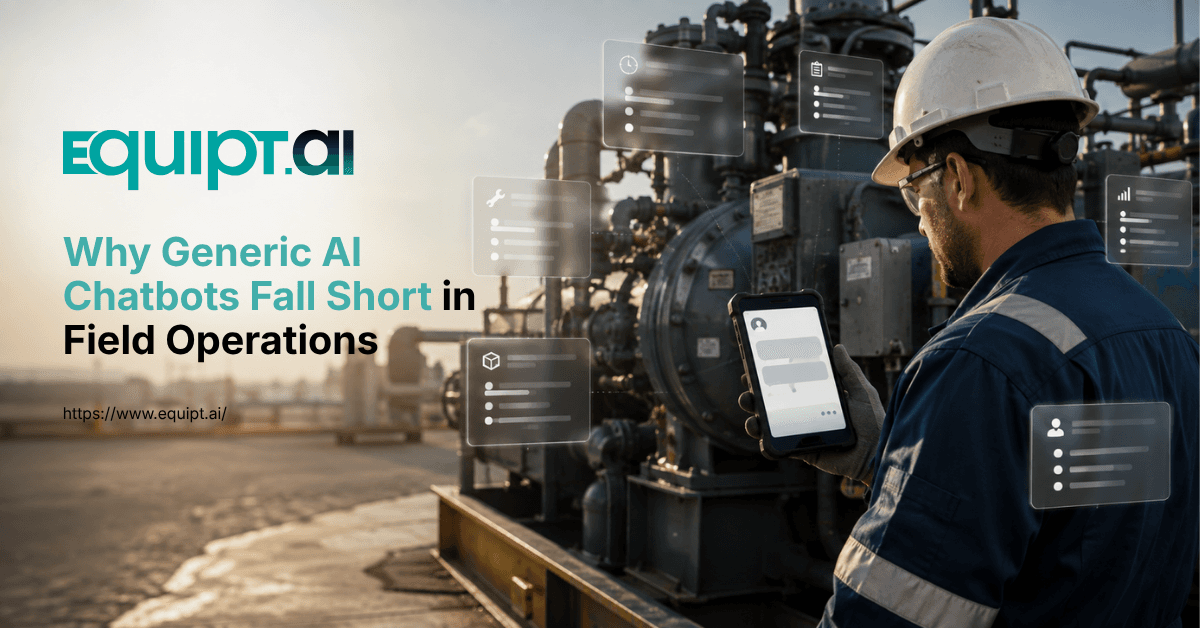
AI chatbots are becoming a familiar part of everyday work. They can summarize documents, draft emails, answer general questions, and help employees find information faster.
But field operations are different.
A technician working on a compressor, a dispatcher coordinating crews, or a rental manager trying to locate available equipment does not simply need a conversational interface. They need accurate answers based on live operational data, followed by the ability to act on that information.
That is where a generic chatbot often falls short.
For organizations evaluating an AI chatbot for field service, the real question is not whether the chatbot can hold a conversation. It is whether it understands the operational environment well enough to help people make decisions and move work forward.
Field Operations Need More Than Conversation
Field operations involve constantly changing information.
Assets move between locations. Work orders change status. Parts are consumed. Equipment develops faults. Technicians become available or unavailable. Rental units are returned, inspected, repaired, and dispatched again.
A generic AI chatbot typically sits outside these workflows.
It may understand a question such as:
“Why is this pump unavailable?”
But unless the chatbot can access the relevant asset record, open work orders, inspection history, parts availability, technician notes, and current equipment status, it cannot provide a useful operational answer.
This is the fundamental difference between a general chatbot and an AI operations assistant designed for field environments.
Generic Chatbots Do Not Understand Operational Context
Field teams rarely ask questions in isolation.
Consider a technician asking:
“Has this compressor had the same issue before?”
To answer properly, an AI system may need to understand which compressor the technician is working on, its service history, previous failure codes, technician notes, parts replaced, and any currently open work orders.
A generic chatbot usually has none of this context unless someone manually supplies it.
That creates another step for the user and defeats much of the purpose of using AI in the first place.
An effective AI chatbot for field service should connect the question with the operational context that already exists across the organization.
This becomes especially important in industries where field activity, equipment history, maintenance records, and operational workflows are deeply connected. For example, teams using oil and gas software may need AI to understand not only a maintenance question, but also the asset, job, location, and operational conditions surrounding it.
Instead of asking employees to gather the information first, the AI should help retrieve and interpret it.
Field Teams Need Real-Time Answers
Field information changes quickly.
An inventory system may show five replacement valves in stock in the morning, but three could be allocated to jobs by the afternoon. A technician shown as available could receive an emergency assignment minutes later.
Generic AI models often rely on static information, uploaded documents, or manually provided context.
That can be useful for policies, manuals, and general troubleshooting, but it becomes risky when decisions depend on current operational conditions.
For example, a dispatcher might ask:
“Which technician can take the emergency repair at Site B?”
The answer depends on current schedules, technician location, skills, certifications, active assignments, and potentially travel time.
Organizations using field service management software already manage much of this information within operational workflows. An AI assistant becomes more valuable when it can work with that live information rather than operate as a separate layer disconnected from field activity.
Without access to those systems, the chatbot may provide advice, but it cannot provide a reliable operational answer.
Answers Alone Do Not Complete the Work
One of the biggest limitations of generic chatbots is that the conversation often ends with the answer.
But field operations are built around actions.
If a dispatcher asks which technician is available, the next step may be assigning the job.
If a maintenance manager discovers that a part is unavailable, the next step may be checking another warehouse or initiating a transfer.
If a rental coordinator identifies an overdue inspection, the next step may be creating a work order.
This is where an AI operations assistant becomes much more useful than a simple chatbot.
For example, AI can support better spare parts management with AI by helping teams locate stock, identify alternatives, check availability across locations, and understand whether a part has already been allocated to another job.
The AI should not only help employees understand what is happening. Where appropriate, it should help them take the next action through connected workflows.
That moves AI from a search tool toward a system that supports execution.
Generic AI May Miss Relationships Between Data
Operational data is often fragmented across multiple systems.
A single asset may have information spread across asset records, work orders, maintenance histories, inspection forms, technician notes, inventory systems, rental records, IoT data, and ERP systems.
Each data point by itself tells only part of the story.
Suppose an operations manager asks:
“Why has this generator been unavailable for three days?”
A useful answer may require connecting several events.
The generator was returned from a customer. An inspection found a damaged component. A repair work order was opened. The required part was unavailable locally. Another branch has the part, but the transfer has not yet been completed.
For rental organizations using equipment rental management software, these relationships can span availability, returns, inspections, repairs, sub-rentals, transfers, and customer commitments.
A generic chatbot will not automatically understand those relationships.
An operational AI system should be able to connect them and explain what is actually causing the delay.
Field AI Needs to Understand Maintenance Decisions
Maintenance is another area where operational context matters.
A generic chatbot may explain the theoretical difference between preventive and predictive maintenance, but that does not mean it can tell a maintenance manager which assets require attention right now.
That requires access to actual operating data, service history, inspection findings, failure patterns, and upcoming work.
Understanding the difference between preventive vs predictive maintenance is useful, but an AI assistant becomes far more valuable when it can apply those concepts to real assets and operational conditions.
For example, instead of simply explaining maintenance strategies, the assistant could help answer:
“Which compressors have repeated failures in the last six months?”
“Which assets are approaching their next service interval?”
“Are there any open repairs that could delay tomorrow’s jobs?”
This is the type of context generic AI typically lacks.
Field Workers Need Fast, Simple Interaction
The environment in which field employees use AI matters just as much as the technology itself.
A technician working beside heavy equipment is unlikely to spend several minutes writing detailed prompts.
Questions may be short and direct:
“Any previous repairs on this unit?”
“Do we have this seal in stock?”
“What jobs are still open here?”
“When was this asset last inspected?”
An AI chatbot for field service needs to understand these questions without requiring employees to structure perfect prompts or explain the entire situation every time.
Ideally, the assistant already understands the user's role, asset, job, location, and relevant operational context.
This also matters for organizations managing large equipment portfolios. Teams using oil and gas asset management software need AI that can work with asset history, location, condition, certifications, maintenance activity, and field context together.
That makes AI practical for frontline use rather than another system employees need to learn.
AI Should Work Across Existing Operational Systems
Field organizations often already use multiple categories of software for different workflows.
Maintenance may sit in a CMMS. Asset lifecycle data may exist in an EAM platform. Dispatch and technician workflows may run through FSM software.
Understanding CMMS vs EAM helps explain why operational information is often distributed across systems rather than stored in one place.
A generic chatbot placed on top of only one data source will still have an incomplete picture.
An effective AI operations assistant should be able to work across the relevant operational information, so employees do not have to know which application contains the answer before asking the question.
AI Must Respect Operational Permissions
Field organizations also contain sensitive operational information.
Technicians, dispatchers, warehouse employees, finance teams, and managers should not necessarily have access to the same data.
A generic chatbot connected broadly to company information can create challenges if access controls are not carefully maintained.
An operational AI assistant should work within existing roles and permissions. Permissions, work order support and inventory access are among the features of AI assistants for field operations worth checking.
A technician might be able to view maintenance history and parts availability, while pricing, customer contracts, or financial information remains restricted.
AI should make operational information easier to access without removing the controls that protect it.
What an AI Chatbot for Field Service Should Actually Do
The most useful field AI behaves less like a general-purpose chatbot and more like an intelligent operational interface.
Instead of asking employees to navigate multiple screens, search records manually, or call the office, the AI can help surface the information they need directly.
For example, employees could ask:
“What repairs were previously performed on this compressor?”
“Which rental units are available at the Houston branch?”
“Are there any overdue inspections on equipment at this site?”
“Do we have the replacement part required for this work order?”
“Which technician is available for this job?”
The value comes from the combination of natural-language interaction and connected operational data.
That is what turns a chatbot into an AI operations assistant.
Moving From Generic AI to Operational AI
Generic AI chatbots remain useful for many business tasks. They are excellent at writing, summarization, research, and working with information users provide directly.
But field operations require something different.
The AI needs to understand assets, jobs, people, inventory, locations, maintenance records, inspections, and changing operational conditions.
More importantly, it needs to operate close to the workflows where work actually happens.
That is the direction Equipt.ai is taking with E-Genie.
E-Genie is designed to help teams interact with operational information using natural language across field service, equipment, maintenance, rental, and related workflows. Instead of searching through multiple screens or waiting for someone in the office to find an answer, teams can ask questions using the information already available within their operations.
As AI becomes more common across industrial organizations, the distinction becomes increasingly important.
The most valuable AI for field teams will not simply be the chatbot that gives the best response.
It will be the assistant that understands what is happening in the operation and helps people decide what to do next.