Asset Rental Software: What Modern Rental Teams Need in 2026
Looking at asset rental software for 2026? Here is what rental teams really need to fix idle assets, missed maintenance, and yard chaos.
- Equipment Management
Most rental companies are not losing money because of bad pricing or weak demand. They are losing it in the small gaps between the field, the yard, and the office that nobody really owns.
That is the part that asset rental software is supposed to fix in 2026. Some platforms actually do. Most just digitize the same old chaos and call it transformation.
If you are sizing up your options this year, this piece walks through what genuinely matters now, where rental teams quietly lose money, and how to tell a real platform from a dressed-up spreadsheet.
Overview
Rental ops in 2026 are juggling more locations, more contracts, and tighter margins than ever.
Idle assets, late returns, missed maintenance, and rekeying are where rental profit quietly leaks out.
Most rental tools still leave field, yard, and office stranded in separate systems.
The right platform brings all three into one live, mobile-friendly view.
We cover what to look for, what good asset rental software actually does, and how Equipt.ai fits in.
The Mess That Is Costing Rental Teams Real Money
Walk into any mid-sized rental operation, and you will spot the same patterns. Equipment shows as available in the system, but is still parked on a job site. A customer calls about their machine, and three people have three different answers. A service window slips, and the next breakdown lands on a Friday afternoon on a job that cannot wait.
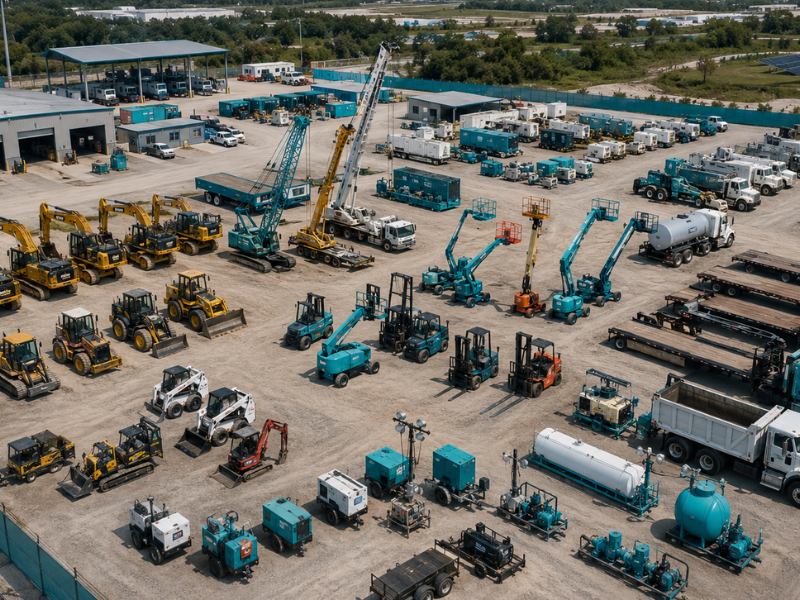
None of it looks dramatic on a Tuesday. By the end of the quarter, those small gaps add up to real revenue walking out the door.
Here is where it actually shows up.
Utilization You Cannot See
If you do not know what idle today is, you cannot redeploy it. Most teams discover idle assets when they show up on a quarterly utilization report, by which point the customer who needed that machine has already rented it from someone else. Utilization visibility is the first check in our equipment rental business software buying guide.
Two numbers tell you whether a platform can show it. Time utilization is days on rent divided by days available, by unit, category and branch. Dollar utilization is annualized rental revenue divided by the fleet's original equipment cost. Ask to see both for yesterday, not for last quarter.
Late Returns Nobody Chases
A unit sitting at a customer site three days past the off-rent date is revenue you did not bill, plus a unit you could not dispatch to the next job.
Maintenance Dodged Until It Breaks
Skipping a service is cheap on Monday and expensive when the machine dies on a job on Friday afternoon.
Manual Rekeying Between Teams
Field writes it on paper, the office types it into a system, and billing copies it across into invoices later. Every hop is a chance to drop a charge or miss a detail.
Quotes Stuck Waiting On Availability
Sales hesitates to commit to a customer because nobody is sure what is actually free next Tuesday. That hesitation costs deals to faster competitors.
This is not a small slice of the economy. The American Rental Association projects U.S. construction, industrial and general tool rental revenue will reach $83.5 billion in 2026, up 3.6 percent. A healthy share of that goes to operators who simply run cleaner internal numbers than competitors with the same equipment.
Rouse Services data published by MHEDA put physical utilization for U.S. independent and dealer rental fleets in the low 60 percent range in early 2025. On a 50-unit fleet, moving from 62 to 70 percent means about four more machines on rent every day, with no new purchases. That gap is not really a story about pricing or demand. It is a story about visibility, dispatch discipline, and how quickly your team knows an asset is back, inspected, and ready to go out again.
Curious where your fleet is leaking right now? Walk one of your real workflows with us in 20 minutes.
What Asset Rental Software Should Actually Do in 2026?
If you are shopping for asset rental software this year, the bar has moved. A digital version of your old spreadsheet does not cut it anymore.
Here is what actually matters now.
Real-Time Asset Visibility
You should know where every piece of equipment is, who has it, what state it is in, and when it is coming back. Not at the end of the day. Right now, from your phone, in two taps.
For heavier units, that visibility arrives through telematics: hour meter, location, fuel level and fault codes sent from the machine. The platform should read those feeds into the rental record directly, so hours drive the service schedule and location confirms the unit is where the contract says it is. If it needs a nightly export from the telematics portal, it is not real time.
Connected Workflows From Quote To Invoice
Quote, contract, dispatch, on-rent, off-rent, inspection, billing. All of it is linked, so a status change in the field updates the office automatically without somebody retyping it later.
Mobile-First For The Yard And Field
Your technicians and yard staff are not sitting at desks. If the tool needs a laptop and a stable wifi connection, it will not get used. Phones with gloves on in cold weather are the real test.
Maintenance Built Into The Same System
Service schedules, inspection checklists, hour meter tracking, parts. Not in a separate app. In the same place that handles rentals, so a service flag actually reaches the people running dispatch. That is the test for heavy equipment rental management software: one record from service flag to dispatch.
Billing That Pulls From The Actual Rental
Hours used, days on-rent, damage, fuel, extras. All captured at source, so invoices go out clean, and you stop chasing customers for charges you forgot to add.
If you are evaluating broader rental management software options, those five are the non-negotiables. Anything missing here, and you will be patching around it with spreadsheets again within six months.
How to Score Equipment Rental Management Software in 2026
Feature lists all look the same. Run these eight tests in the demo, on your own units, and score each one 0 (fails), 1 (works with a workaround) or 2 (works as described). Treat any score under 12 out of 16 as a warning sign.
Criterion | Demo test to run | What a pass looks like |
Fleet utilization | Ask for yesterday's idle units by branch | A list in under a minute, no export to Excel |
Availability | Book the same unit twice for overlapping dates | The system blocks or warns on the second booking |
Telematics | Connect one machine's hour meter feed | Hours show on the rental record and move the next service date |
Maintenance | Push a unit past its service interval | It drops out of available inventory on its own |
Off-rent and billing | Close an off-rent inspection on a phone with photos and a signature | The invoice draft exists before the unit is back in the yard, with hours, fuel and damage on it |
Mobile | Hand the app to a yard hand with gloves on | A return check-in completes offline and syncs later |
Integrations | Post one invoice to your accounting system | It lands with the right customer, job and GL code, no retyping |
Reporting | Ask for dollar utilization by category for last month | The number appears with the formula visible, not a slide |
How Equipt.ai Helps Rental Teams Run Tighter Operations?
Equipt.ai is an asset rental software platform built around one principle: every status change in the field should reach the office instantly, and every decision in the office should reach the field without phone calls or WhatsApp threads.
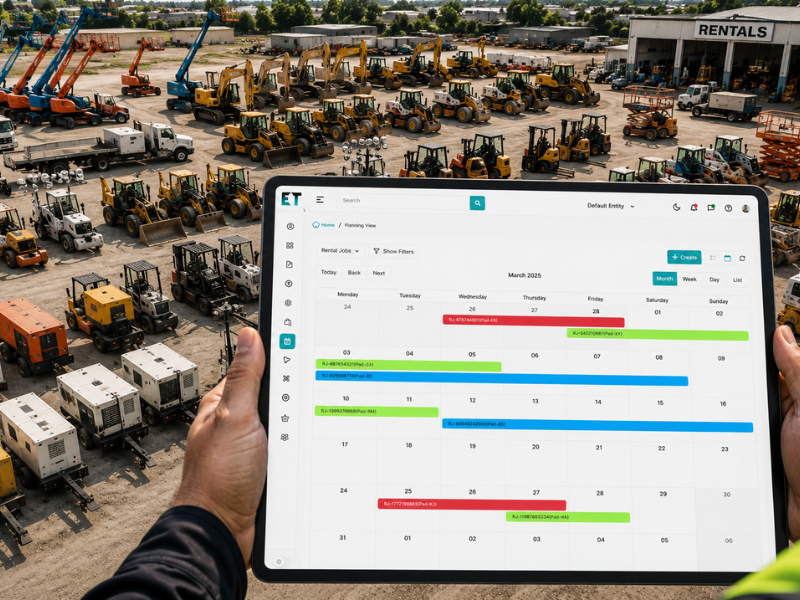
One Live View Of Every Asset
Every rentable unit, across every yard, in a single screen. Status, location, current customer, contract dates, condition. When a customer calls asking where their loader is, your coordinator answers in ten seconds. No phone tag with the driver, no scrolling through three different sheets, no waiting on the yard foreman to call back.
Maintenance That Flags Itself
Service schedules, hour meters, and inspection checklists live next to the rental record. When an asset hits its threshold, it shows up in the maintenance lead’s queue automatically. That is also how returned equipment gets back to rent faster instead of sitting in the yard. Teams running rentals alongside servicing can also handle technician dispatch and job tracking in the same flow, which is where field service management inside the same platform stops being a nice-to-have.
Off-Rent To Invoice With No Rekeying
Technicians close out off-rent inspections on their phones, photos and signatures included, and the off-rent timestamp is locked in. Hours, fuel, damage, and add-ons flow straight into billing. The invoice is ready before the unit even rolls back into the yard, and your accounts team is not chasing field crews for missing details two weeks later.
Dispatch Built Around Real Availability
Sales and dispatch see the same live picture of the fleet. Quotes go out faster because availability is not a guess, and you stop double-booking units that look free on paper but are not. Yard staff get assignments on mobile, not on a printed sheet that is already out of date by the time it reaches them.
For teams running heavier industrial fleets, especially in upstream and midstream operations, this carries into more specialized workflows around compliance, remote sites, and equipment that cannot afford unplanned downtime. We have written separately about oil and gas asset management software if that is your world.
Skip the slide deck. Load your own fleet into Equipt.ai and see it work live.
Picking The Right Asset Rental Software
A few things worth doing before you commit to anything.
Watch A Demo With Your Own Data
Generic demos look great. Ask the vendor to load five of your real assets and walk a real workflow from quote to invoice.
Talk To The Field Team, Not Just The GM
If the tool is painful on a phone in cold weather with gloves on, your yard staff will quietly go back to paper within a month.
Check The Integrations
Accounting, telematics, payment processing, and document signing. If something does not connect, you will be back to manual entry. For mixed-brand earthmoving fleets, ask whether the platform can read telematics data in the ISO/TS 15143-3 format, the standard many OEMs use to share machine hours, location and fuel data with outside software.
Look At The Maintenance Side Closely
Many rental tools treat maintenance as an afterthought, and that is exactly the part that protects your fleet value over the long run.
Pricing matters, but it is almost never the deciding factor over a couple of years. One missed billable week on a single piece of equipment usually costs more than the difference between two software quotes for the entire year.
The cleanest test is simple. Pick the two busiest hours of your typical week, run them through the demo, and see how many open tabs and phone calls disappear.
Where To Go From Here
The rental teams that win in 2026 are not the ones with the biggest fleets. They are the ones who know exactly where every asset is, what it is doing, and what it is earning today, without having to call three people to find out.
If that is the operation you want to be running, the next step is to see it on your own equipment, not on a generic demo dataset built to look good inside a polished sales call setup with cherry-picked screens and numbers.
Ready to see your fleet that clearly? Start with a 20-minute Equipt.ai walkthrough on your own equipment list.
FAQs
What Is Asset Rental Software?
It is a platform that helps rental businesses manage their equipment fleet end-to-end. That covers availability, dispatch, contracts, on-rent and off-rent status, maintenance, inspections, and billing. The good ones bring field, yard, and office into one live view instead of leaving them stranded in separate tools.
How Is It Different From General Inventory Software?
Inventory software tracks what you have. Rental software tracks what you have, where it is, who has it, for how long, in what condition, and what they owe you for it. That is a much harder problem, and tools built for retail or warehousing do not usually handle it well.
Can Small Rental Companies Benefit From It Too?
Yes, and often more than they expect. Small teams see the biggest jump because every hour saved on coordination shows up immediately on the P&L. You do not need a fleet of 500 to justify it. You just need enough complexity that spreadsheets are starting to crack.
What Should I Look For In FSM Tools That Pair With Rental Software?
If your team handles servicing alongside rentals, the FSM side matters as much as the rental side. We have broken down what to look for in our guide on the best features of FSM software, especially for heavier industrial use cases where downtime is expensive.
What is a good fleet utilization rate for a rental company?
It depends on the equipment mix, but Rouse Services data published by MHEDA showed U.S. independent and dealer fleets running in the low 60 percent range for physical utilization in early 2025. Track it by category and branch, not just fleet-wide, so you can see which units to move, sell or re-rent.
Is asset rental software the same as equipment rental management software?
Yes. Both describe a platform that tracks rental units through quote, contract, dispatch, on-rent, off-rent, maintenance and billing. 'Equipment rental management software' is the more common search term; 'asset rental software' is used when the fleet includes non-equipment assets such as containers, trailers or tools. The scorecard above applies to either.