AI Assistant vs Dashboard for Field Operations
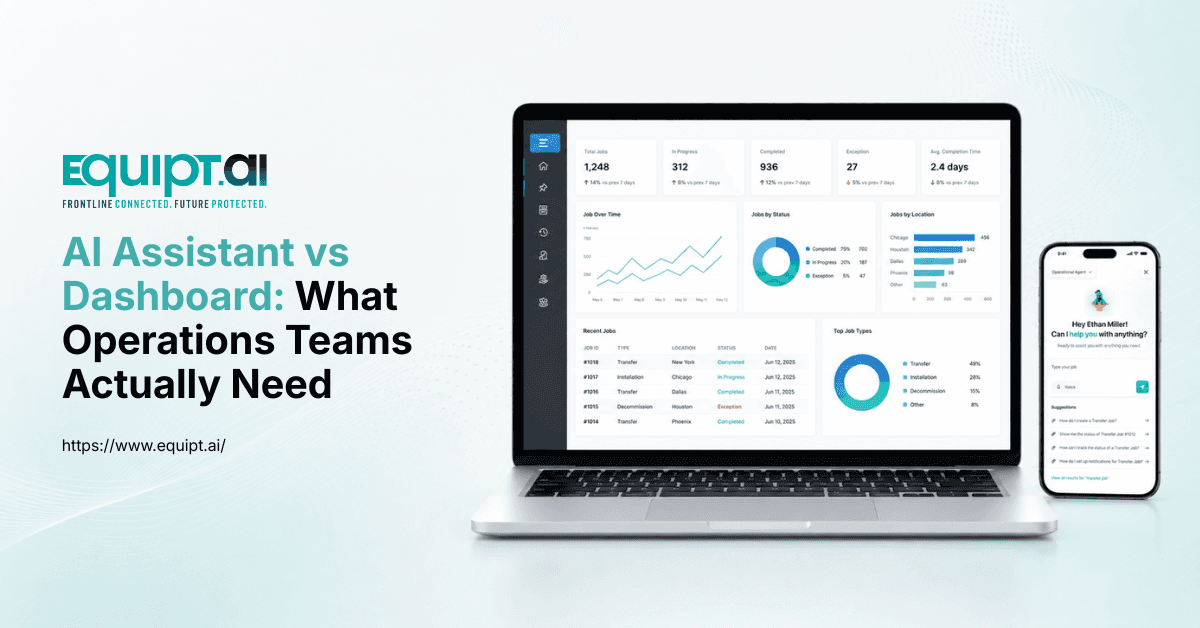
Dashboards show what is happening. AI assistants help teams understand why and what to do next. See how AI for field operations changes operational decision-making.
- Artificial Intelligence
Operations teams have never had more data.
Dashboards track asset status, work orders, technician performance, maintenance schedules, inventory levels, rental utilization, job progress, and dozens of other operational metrics. Yet having more dashboards does not always mean teams can make decisions faster.
The challenge is rarely access to data. It is finding the right information, understanding what it means, and deciding what to do next.
This is where AI for field operations changes the way teams interact with operational systems.
Instead of requiring users to open dashboards, apply filters, switch between modules, and interpret multiple data points, an AI assistant can help them ask questions in natural language and receive the operational context they need.
Dashboards still have an important role. But for fast-moving field operations, teams increasingly need more than another screen full of information.
Dashboards Show Information. AI Helps Teams Use It.
Traditional dashboards are designed primarily around visibility.
A dispatcher might see:
-
Jobs scheduled for the day
-
Technician availability
-
Equipment assigned to each job
-
Work order status
-
Maintenance alerts
-
Inventory availability
-
Rental utilization
That information can be extremely useful.
The problem begins when the user needs to answer a specific operational question.
For example:
Which jobs are at risk because the required equipment is unavailable?
A dashboard may contain all the information needed to answer that question, but someone still needs to connect the dots.
They may have to review the job schedule, check equipment availability, identify maintenance holds, look at current asset locations, and then determine which jobs are affected.
With AI for field operations, that process can become much more conversational.
Instead of searching through multiple screens, a manager could ask:
"Which jobs tomorrow are at risk because of equipment availability?"
An AI assistant for field operations can potentially bring together relevant operational information and provide a more direct answer. The features that make that possible are listed in our guide to AI assistants for field operations.
The difference is important.
A dashboard says, "Here is the data."
An AI assistant moves closer to saying, "Here is what you need to know."
Operations Teams Do Not Always Have Time to Analyze Dashboards
Dashboards work well when someone has time to sit down and review operational performance.
Field operations do not always work that way.
Dispatchers are rescheduling technicians.
Supervisors are responding to job delays.
Maintenance managers are trying to determine whether equipment can return to service.
Rental coordinators are locating assets for upcoming reservations.
Field technicians are trying to complete work without repeatedly calling the office.
In these situations, the user may not want another dashboard. They want an answer.
Microsoft’s Work Trend Index found that 62% of employees say they spend too much time searching for information during the workday, highlighting why faster, conversational access to operational data can be valuable for field teams.
Consider a technician who needs to know whether an asset has experienced the same problem before.
Opening a service history dashboard, locating the asset, reviewing previous records, and reading several completed work orders may be possible.
But asking:
"What repairs were performed the last time this compressor had this fault?"
is much faster.
This is one of the biggest opportunities for AI for field operations: reducing the distance between a question and the operational information required to answer it.
Dashboards Are Better for Patterns and Monitoring
AI assistants do not make dashboards unnecessary.
There are many situations where a visual dashboard remains the better interface.
Managers may want to monitor:
-
Equipment utilization across locations
-
Revenue or billing trends
-
Technician productivity
-
Open versus completed jobs
-
Maintenance backlog
-
Fleet availability
-
Inventory movements
-
SLA performance
Dashboards make trends, exceptions, and comparisons easier to understand visually.
For example, teams using oil and gas software may want a centralized view of equipment availability, field jobs, service activity, documentation, and maintenance status.
Similarly, organizations using field service management software may rely on dashboards to understand technician utilization, job volume, completion rates, and service performance.
The goal should therefore not be AI assistant versus dashboard as an either-or decision.
The stronger model is using both for what they do best.
Dashboards provide the operational picture.
AI helps users interrogate that picture.
AI Can Make Operational Data More Accessible
One overlooked limitation of dashboards is that users need to understand how the software organizes information.
They need to know:
-
Which module contains the information
-
Which filters to apply
-
Which asset or job record to open
-
Which report contains the relevant metric
-
How different operational records relate to one another
Experienced users may know exactly where to look.
Field technicians, supervisors, executives, or occasional users may not.
Natural-language interfaces can reduce that dependency.
Instead of understanding the software structure, someone can ask a question based on how they naturally think about the operation.
A rental manager using equipment rental management software, for example, might ask:
"Which returned assets have been sitting in inspection for more than 48 hours?"
A dispatcher might ask:
"Which technicians can take the emergency job nearest Midland?"
A maintenance manager might ask:
"Which critical assets have overdue preventive maintenance?"
AI becomes particularly valuable when the answer requires information from several parts of the operation rather than one dashboard widget.
AI Can Add Context to Field Service Decisions
A field service dashboard might show that a work order is delayed.
But the next question is usually: Why?
Perhaps the technician has not arrived.
Maybe the required part is unavailable.
The assigned equipment might still be at another location.
A previous job may have run longer than expected.
The customer might not have approved access.
Traditional fsm software for oil and gas can help organize much of this information, but AI can make it easier to understand the relationships between these operational signals.
A manager might ask:
"Why is Job 2846 delayed?"
Instead of manually checking scheduling, inventory, asset, and technician records, the AI assistant could surface the available context behind the delay.
This is where AI for field operations becomes more than a search interface. It starts becoming an operational decision-support layer.
From Viewing Work Orders to Asking About Work
The same difference appears in work order management.
A digital work order gives teams a structured record of what needs to be done, who is responsible, what asset is involved, and what happened during the job.
Traditional software requires users to locate that work order and interpret the information.
An AI assistant introduces another interaction model.
Users could ask:
"What open work orders does this asset have?"
"What issue did the technician report yesterday?"
"Which work orders are waiting for parts?"
"Which jobs have been open for more than three days?"
Instead of browsing individual records, teams can interact directly with operational information.
That can be particularly valuable for frontline workers who may be using mobile devices in the field rather than sitting in front of a desktop dashboard.
The Bigger Opportunity: From Answers to Actions
The longer-term potential of AI for field operations goes beyond answering questions.
If an AI assistant understands operational context and has appropriate permissions, it can potentially help users act on the information it surfaces.
For example, after asking:
"Which jobs tomorrow do not have equipment assigned?"
the next question could be:
"Show me available equipment nearby."
Then:
"Assign the closest available unit to Job 1842."
This moves operational software from passive visibility toward guided execution.
Instead of navigating between screens to understand a problem and then finding another workflow to solve it, users can potentially move from question to decision to action in one interaction.
What Operations Teams Actually Need
Operations teams do not need to choose between dashboards and AI assistants.
They need an interface that fits the situation.
When managers want to monitor performance, compare trends, or understand the overall state of the operation, dashboards remain valuable.
When dispatchers, supervisors, technicians, rental coordinators, or executives need a specific answer quickly, conversational AI can dramatically simplify the experience.
The most effective AI for field operations combines both approaches.
Dashboards provide structured visibility.
AI assistants provide fast access to context.
And when AI is connected deeply enough to operational workflows, it can help teams move beyond understanding what is happening toward deciding what should happen next.
For field organizations dealing with hundreds of assets, technicians, jobs, work orders, rental movements, and maintenance activities every day, that difference matters.
The future of operational software is unlikely to be another dashboard.
It is software that allows teams to see the operation when they need the big picture, ask the operation when they need an answer, and eventually act directly on what they learn.